 11
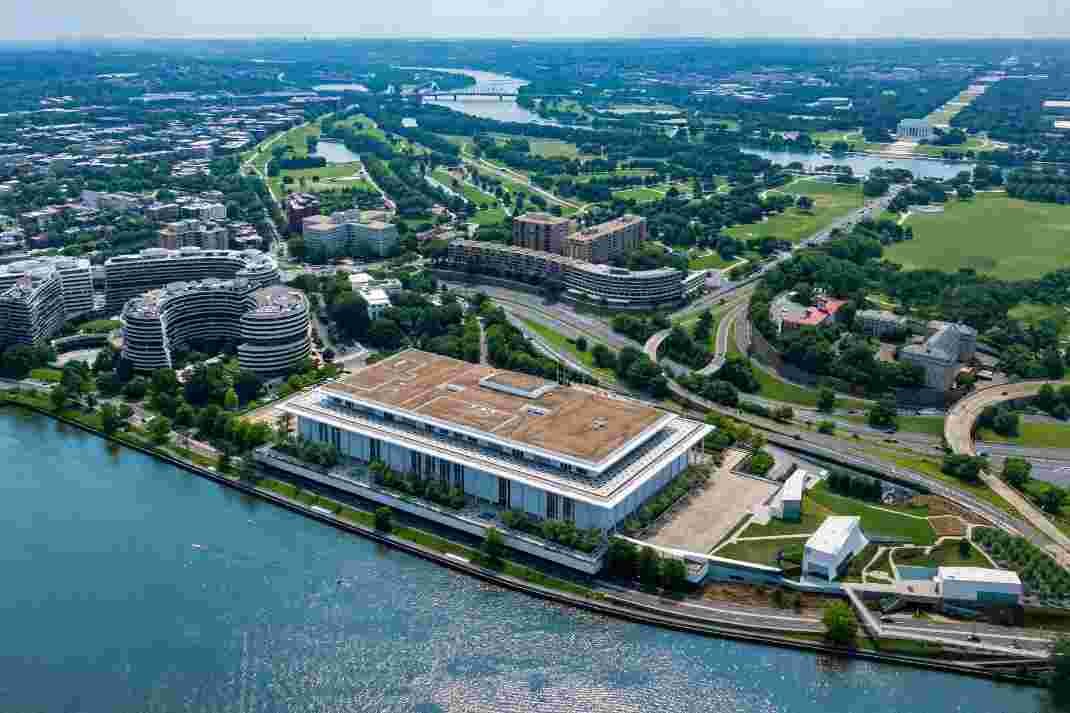
The question of whether the Kennedy Center is a federal building gets answered wrong in a lot of casual conversation, usually because people conflate three separate things: who owns the real estate, who pays for the upkeep, and who has legal authority over the place. The John F. Kennedy Center for the Performing Arts sits on land owned by the United States government, receives annual federal appropriations for building operations, and is subject to federal oversight structures that no ordinary private venue carries. That combination is why any honest answer to “is the Kennedy Center a federal building” has to start with the statute rather than the letterhead, and the statute is the National Cultural Center Act of 1958, amended in 1963 and again in 1994.
For contractors, property managers, and developers who work around institutional assets in Washington, D.C., the federal status question is not trivia. It determines which procurement rules apply to renovation work, which wage determinations govern the trades on site, and which agency gets to sign off on a roof replacement or a mechanical upgrade. The Kennedy Center occupies a strange middle zone that resembles a federal building in some respects and a nonprofit in others, and the line between those two is worth mapping precisely.
Congress chartered the Kennedy Center as a private, nonprofit corporation, not as an executive branch agency. The Kennedy Center’s own institutional history describes the entity as a bureau-like trust established by federal law but governed by a board of trustees rather than a cabinet secretary. That structure matters because federal agencies answer to the President through the chain of command, while the Kennedy Center’s trustees operate with a degree of independence that no General Services Administration regional office enjoys.
So the narrow legal answer to is the Kennedy Center a federal building is this: it is a federally chartered facility on federal land with federal funding obligations, but it is not a federal agency building in the sense that the GSA manages it as part of the federal real property inventory. The distinction shows up in the fine print of lease agreements, insurance policies, and procurement solicitations, and it catches out contractors who assume that any building with a congressional appropriation behaves like a courthouse.
The original legislation authorized a National Cultural Center and set up a board to raise private money for construction. After President Kennedy’s assassination in 1963, Congress renamed the project and expanded the federal commitment, and the building opened in 1971 on a site adjacent to the Potomac River near the Watergate complex.
The charter language establishes the Center as the nation’s living memorial to President Kennedy, which is the legal hook that justifies ongoing federal support. That memorial designation is why the funding stream has survived budget cycles that killed plenty of other cultural subsidies.
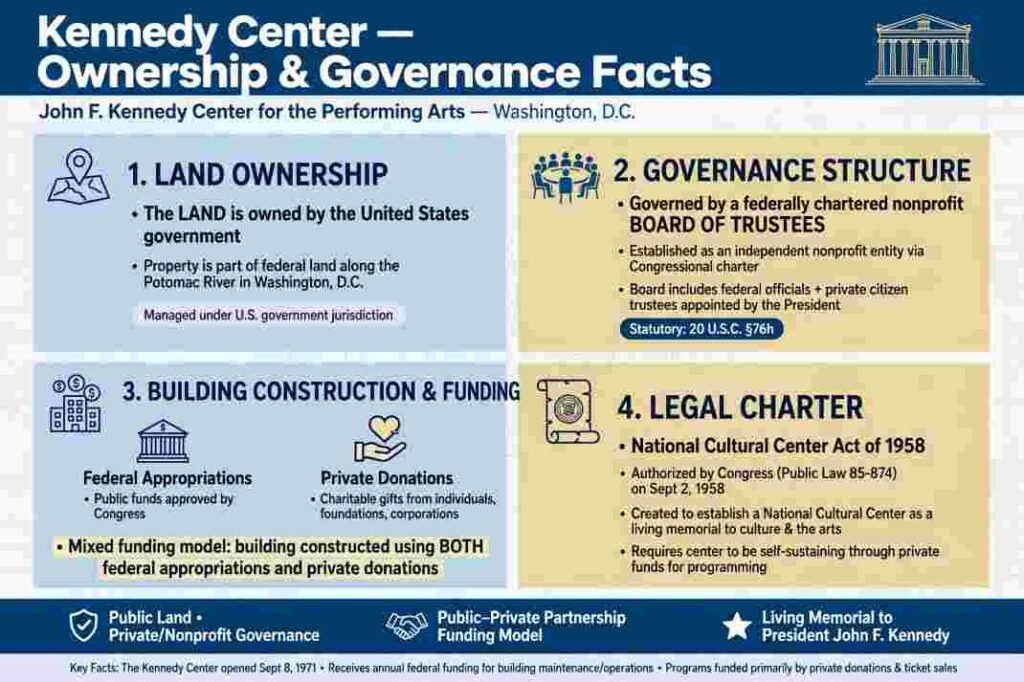
The land under the Kennedy Center belongs to the federal government, and the building itself was constructed with a mix of federal appropriations and private donations raised through the board. That split funding model created the ownership ambiguity that still confuses people today. The federal government put up the initial construction money, private donors matched a substantial portion, and the resulting asset sits in a category that the GSA federal real property portfolio treats with special handling rather than as a standard agency asset.
On the operations side, Congress appropriates funds annually for building maintenance and security, which is the strongest argument for calling the Kennedy Center a federal building in practical terms.
Those appropriations flow through the Department of the Interior’s National Park Service in some years and through direct line items in others, and the reporting requirements attached to that money look a lot like the obligations imposed on any federal facility.
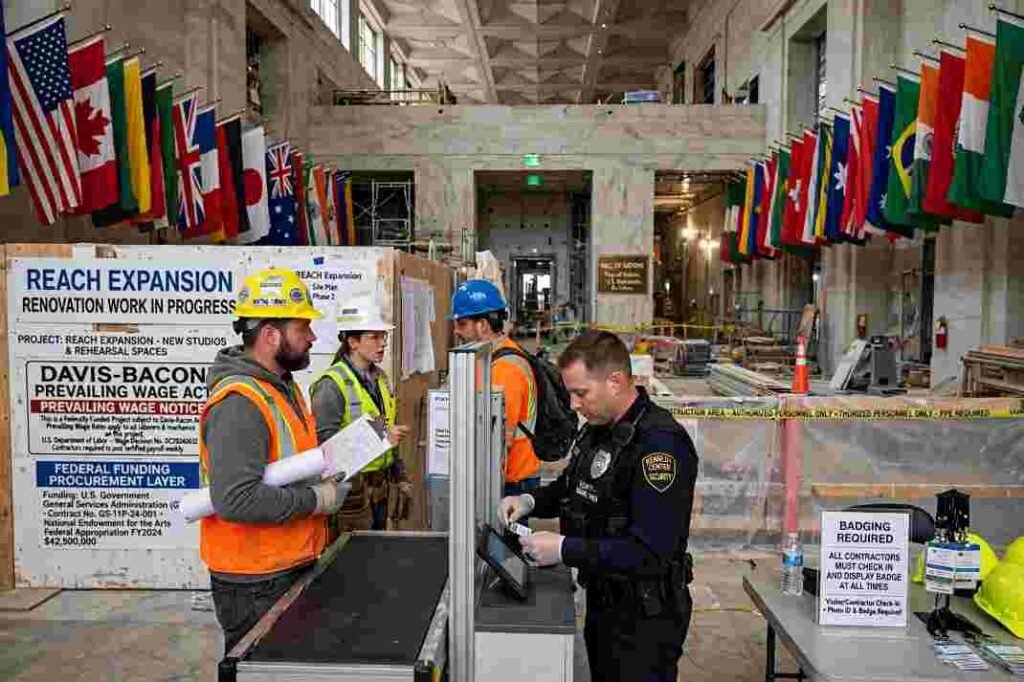
A contractor performing work funded by those appropriations faces Davis-Bacon prevailing wage requirements, Buy American provisions, and the same subcontracting reporting that governs a federal office building renovation.
Whether a given project at the Kennedy Center follows Federal Acquisition Regulation rules depends on the funding source attached to that specific scope of work. A privately funded donor project inside the building may follow the Center’s internal procurement policies, which resemble those of a large nonprofit. A project funded by the annual federal appropriation will generally require compliance with FAR Part 22 labor standards, including wage determinations and certified payroll submission. That bifurcation is the single most important operational fact for anyone bidding work there.
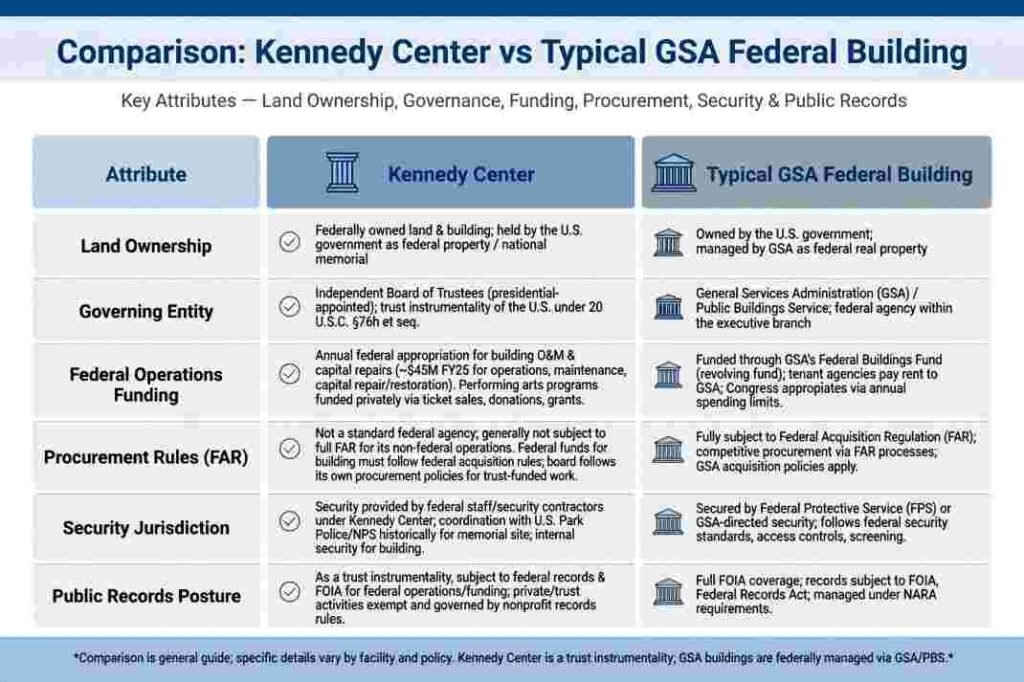
| Attribute | Kennedy Center | Typical GSA Federal Building
|
|---|---|---|
| Land ownership | United States government | United States government |
| Governing entity | Federally chartered nonprofit board of trustees | Federal agency under GSA custody |
| Annual federal operations funding | Yes, through congressional appropriation | Yes, through agency budgets |
| Procurement rules | Mixed, depends on funding source for each scope | FAR applies across the board |
| Security jurisdiction | Federal protective arrangements with internal coordination | Federal Protective Service |
| Public records posture | Partial, subject to charter and funding conditions | Full federal records obligations |
That table is a simplification, and any bidder should read the specific solicitation rather than rely on a general comparison. The point is that the answer to is the Kennedy Center a federal building shifts depending on which layer of the operation you examine, and the funding source is the layer that governs most construction and maintenance work.
Anyone who has walked through the Hall of Nations or the Hall of States has noticed the security screening, the uniformed officers, and the restricted service corridors. That apparatus exists because the Kennedy Center’s federal designation triggers protective responsibilities that a purely private theater would not carry. The Federal Protective Service within the Department of Homeland Security handles security for federal facilities generally, and the Kennedy Center’s arrangements coordinate with that framework while retaining internal management of day-to-day visitor operations.
For construction crews, that security posture translates into badging requirements, escorted access to certain mechanical spaces, and background check timelines that add weeks to mobilization. A subcontractor who has worked at a private performing arts venue in another city will find the access protocol at the Kennedy Center closer to a federal courthouse than to a regional theater. Deliveries get screened, tool inventories get logged, and the schedule absorbs the friction. Contractors who fail to price that friction into their bids end up eating the cost.
The Kennedy Center has undergone major capital work over the decades, including the REACH expansion that opened in 2019 and various mechanical and envelope upgrades. Those projects illustrate the mixed-funding reality in concrete terms: the REACH was funded primarily through private philanthropy, while base building systems work has drawn on appropriated funds.
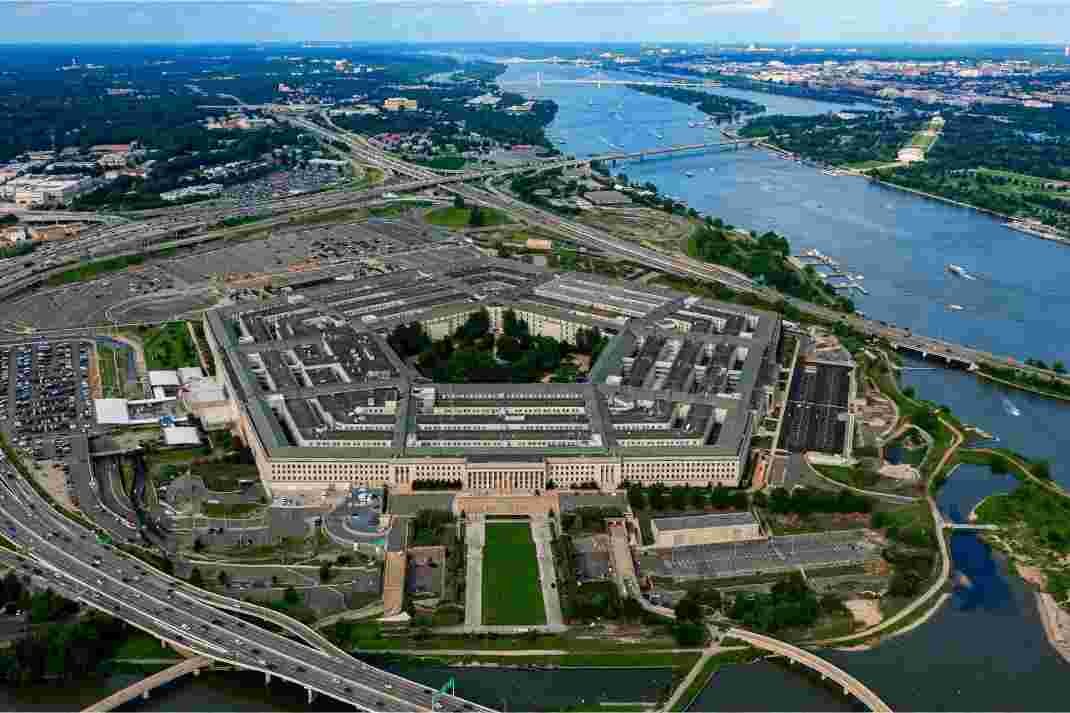
When people ask is the Kennedy Center a federal building, the honest answer often depends on which phase of construction they are looking at. Unlike a purely governmental installation like the Pentagon building, a project funded by donors follows one rulebook, and a project funded by Congress follows another, and both can be happening in adjacent spaces during the same fiscal year.
Three forces keep the question alive. First, the name itself, since “national” and “center” together signal public ownership to most Americans. Second, the physical presence on federal parkland near the Potomac, which reads as government property to any passerby.
Third, the annual appropriations line item, which shows up in federal budget documents and reinforces the impression that the Center is an agency operation. None of those signals is wrong exactly, but each one captures only part of the picture, and the legal structure sits underneath all of them in a way that casual observation cannot detect.
The congressionally mandated oversight reports also contribute, because they describe the Center’s financial relationship with the federal government in language that sounds like agency reporting. A reader who skims one of those documents could reasonably conclude that the Kennedy Center is a federal building in the fullest sense, and the document would not be lying, just incomplete. Precision requires reading the charter alongside the appropriation language, which almost nobody does outside of a handful of procurement offices and legal departments.
If you are bidding work at the Kennedy Center, the first move is to identify the funding source for the specific scope and read the solicitation for wage determination and reporting requirements. Do not assume FAR compliance because the building looks federal, and do not assume nonprofit treatment because the operating entity is a nonprofit corporation. Whether dealing with a local cultural venue or massive capital projects on par with the most expensive building in the world, the funding source is the controlling variable, and it can change from project to project within the same building envelope.
Insurance and bonding deserve separate attention. A project on federal land can trigger additional insurance requirements, and the surety underwriting for work at a federally chartered institution sometimes gets complicated by the ownership structure. Get the certificate requirements in writing before you commit to a schedule, because the Center’s risk management office will have specific expectations that differ from a standard commercial job.
For a broader look at how public and institutional projects differ from private work, the Census Bureau construction spending data separates public from private categories in a way that reflects these structural distinctions at the national level.
Performances run nearly every night of the year, which means construction access gets compressed into daylight hours and dark weeks. Mechanical work in the theaters, rigging replacements, and HVAC upgrades all have to thread through rehearsal and performance calendars that leave little margin.
Contractors who have not worked in an active performance venue underestimate how much schedule gets consumed by load-in and load-out windows, and at the Kennedy Center those windows get tighter because of the security and access controls layered on top. Price the calendar constraints before you sign, not after the first missed milestone.
A federally chartered institution is not the same as a federal agency, and the distinction carries weight in court decisions about records access, employment disputes, and property tax treatment. The Kennedy Center pays no property tax on its land, which is consistent with federal ownership, but its employees are not federal civil servants in the competitive service, and its procurement staff do not answer to the GSA administrator. Those two facts sit awkwardly beside each other, and they are the reason the is the Kennedy Center a federal building question keeps resurfacing in different forms.
Another common error involves the assumption that federal status means congressional approval for every capital project. In practice, some work proceeds under delegated authority while major undertakings require explicit authorization and appropriation. The threshold between those categories is set by the charter and by the terms of each appropriation, and it has shifted over time as Congress has revised the oversight framework. Anyone planning a multi-year capital program at the Center needs to map that threshold early rather than discover it mid-project.
Leadership transitions at the Kennedy Center have drawn attention in recent years, and each transition raises the same underlying question about federal control. The board’s composition, the appointment process for trustees, and the relationship between the board and the sitting presidential administration all bear on how much day-to-day federal influence reaches into operations. Changes in board makeup do not alter the charter, but they can shift priorities around programming, capital spending, and donor relationships in ways that eventually touch the construction calendar.
For anyone tracking the is the Kennedy Center a federal building question, the governance layer is where the answer evolves fastest. The charter is stable, the funding structure moves slowly, and the board composition can change with a single election cycle. Contractors with long-term relationships at the Center should monitor board announcements alongside the appropriations calendar, because the two together shape which projects move forward and which ones stall.
The Kennedy Center is a federal building in the ways that matter for land ownership, appropriations funding, security posture, and procurement compliance on federally funded scopes, and it is not a federal building in the ways that matter for agency chain of command, civil service employment, or GSA property management. Both halves of that sentence are true at the same time, and treating either half as the whole answer will get a bidder into trouble.
The controlling variable for any construction or maintenance project is the funding source attached to that specific scope, and everything else, from wage determinations to badging requirements to insurance certificates, follows from that one fact. Read the solicitation, confirm the funding stream, and price the access constraints before the first site walk, because at the Kennedy Center the paperwork decides the job long before the crew shows up.