
2692815517, 234d1705p005, 888670034033, 829160897561, 2178848984, 10199005007, 79100925025, 721110253680, 73149136510, 16034025050, 31700049716, 2085144125, 18006984431, 2511453c1, 885609010823, 31700058169, 850251004254, 18443295283, 2534596200, 18336510446, 18337232503, 3093226458, 3017668708, 787651122533, 2315981817, 31700049532, 18884093448, 18332147629, 829610004143, 78742431673, 31262103048, 2034462948, 2137721984, 2097308073, 2097308075, 885609027395, 2566296248, 28400071895, 9781338137200, 2138179751, 2485500855, 7398148949, 48867312249, 689604187586, 3029989192, 92636254315, 89991626505, 18337232505, 2677037088, 18009320783, 54000101830, 16000172838, 856603005566, 3023918217, 298389670, 223664791, 2emh01921, 0x82785cf5d11a1feaf80f9db18b40f49268df3d32, 2087834544, 752356829308, 53891106368, 2705139922, 2076077884, 30400793950, 18009473131, 19039009475, 2084883263, 3034919608, 2014466625, 31700049969, 25000040986, 3093200054, 43917101057, 2293540013, 2096458266, 18558722243, 16462258672, 4612193, 18665375162, 2532360471, 808829115628, 2244743167, 2172133410, 18005835698, 2532874460, 2133172858, 3039701007, 18008994047, 18005471743, 817783020404, 18335952214, 44600307138, 813094021840, 2098706700, 2093065739, 1.800.323.9895, 2109886107, 2052240982, 18005567677, 2819255000, 2252394689, 193052027610, 49694993922, 605388024374, 752356824174, 35000740182, 2144534248, 18002769939, 18774489544, 2133443356, 18003972944, 745883784301, 4895176111263, 3017592438, 37000908166, 2012496394, 18.84x18.84, 38675200623, 18773279515, 2035330874, 8274005806, 2199348320, 18004240948, 16146861627, 19148824329, 18005528159, 3107612797, 2097308079, 43935682583, 18882088843, 36504752404, 2622635147, 3078003491, 2032960056, 2148842495, 18008723377, 41458105688, 2153094295, 747599409943, 2148455505, 18883352722, 73149719690, 18003917635, 2512930806, 308978992, 887758092095, 37000822189, 18005537499, 2103618931, 79100149476, 81287038450, 47875323797, 608883000027, 3025494703, 2819685738, 2emh01720, 2154788344, 18003921147, 9800120482, 2678764652, 1a406030000678a000011570, 2814076944, 80196300108, 843461100793, 2568674634, 18336505789, 18004477228, 660708552029, 9800892259, 3107546969, 191174xl, 2195460014, 851861006867, 2097219669, 3054000750, 33500925528, 11120236637, 2136461453, 76828005015, 253.2843281, 3022006842, 18004801045, 37000829126, 3055749896, 3047699880, 305210042223, 2085153325, 18884135067, 18882183919, 17632994345, 2512923034, 3039807300, 9800895007, 2067054013, 885954560493, 2629998017, 3052798222, 3092705002, 31700054543, 18002762722, 17800136402, 18003040282, 2074303836, 295205521, 70183500420, 18335490757, 3059670629, 737416099440, 18556608899, 3055956200, 2674330213, 89121288122, 18664674300

Popular Posts

The Process of Underwater Tunnel Construction How Engineers Build Below Water

The Process of Underwater Tunnel Construction: How Engineers Build Below Water

Underwater tunnel construction is the process of underwater tunnel construction that allows roadways, railways, and utilities to pass beneath rivers, seas, or other water bodies without disrupting surface traffic or shipping lanes. These engineering marvels require meticulous planning, advanced machinery, and highly skilled labor to succeed.

Understanding how these structures are built not only highlights human ingenuity but also explains why careful method selection and precision are essential for safety and longevity. 

What Is Underwater Tunnel Construction?

Underwater tunneling refers to building enclosed passages beneath water bodies that support vehicles, trains, or pipelines. Unlike bridges, tunnels don’t interfere with surface navigation or views, and they can be more resilient in harsh weather conditions.

There are several proven construction methods, each chosen based on water depth, geology, environmental constraints, and project requirements. The three most common are:
  • Immersed Tube Tunnels
  • Bored Tunnels with Tunnel Boring Machines (TBMs)
  • Cut‑and‑Cover Tunnels 

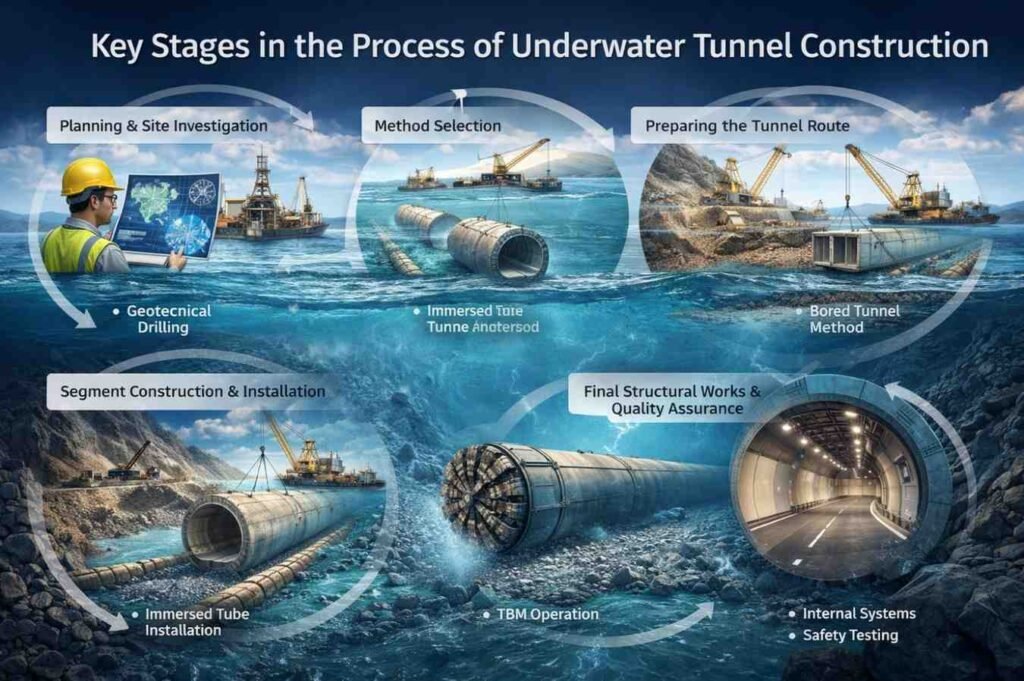
Key Stages in the Process of Underwater Tunnel Construction

Key Stages in the Process of Underwater Tunnel Construction

Understanding the workflow of underwater tunnel projects helps reveal both their complexity and elegance.

1. Planning and Site Investigation

In this crucial stage, engineers must conduct thorough surveys and geotechnical investigations to evaluate the ground and water conditions. Environmental impact assessments are also performed to minimize disruptions to the surrounding ecosystem. To ensure sustainability, some projects may adopt eco-friendly practices, such as green building certifications.

  • Geotechnical drilling to sample soil and rock types
  • Hydrological studies to assess water currents and pressures
  • Environmental impact assessments

These early studies determine which construction method will be safest and most cost‑effective.

2. Method Selection

Selecting the right method is a cornerstone in the process of underwater tunnel construction:

  • Immersed Tube Method: Best for shallow and medium‑depth bodies of water. Segments are built on land, floated to the site, sunk into a pre‑dredged trench, connected, and sealed. 
  • Bored Tunnel Method: Suitable for deeper water and complex geology. A tunnel boring machine (TBM) drills through soil or rock, installing tunnel lining as it progresses. 
  • Cut‑and‑Cover Method: Useful near shorelines where a trench is excavated and covered over after construction.

3. Preparing the Tunnel Route

Depending on the method:

Immersed Tube Preparation

  • A trench is dredged along the tunnel’s alignment, often using specialized dredging equipment.
  • Foundations are prepared to ensure a stable bed for the tunnel units. 

Bored Tunnel Access

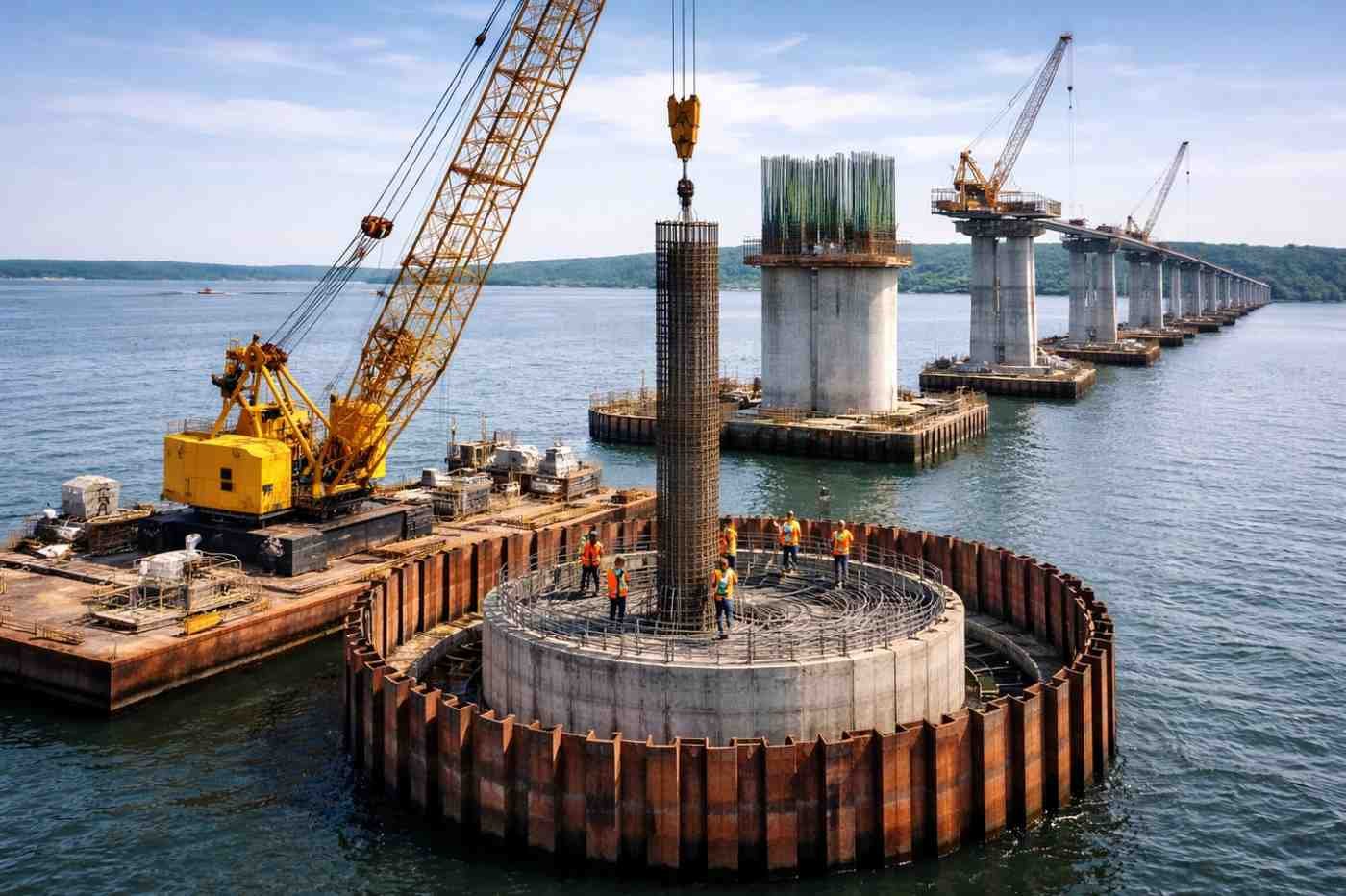
  • Launch shafts are excavated where TBMs begin boring.
  • Support structures and logistics zones are established. 

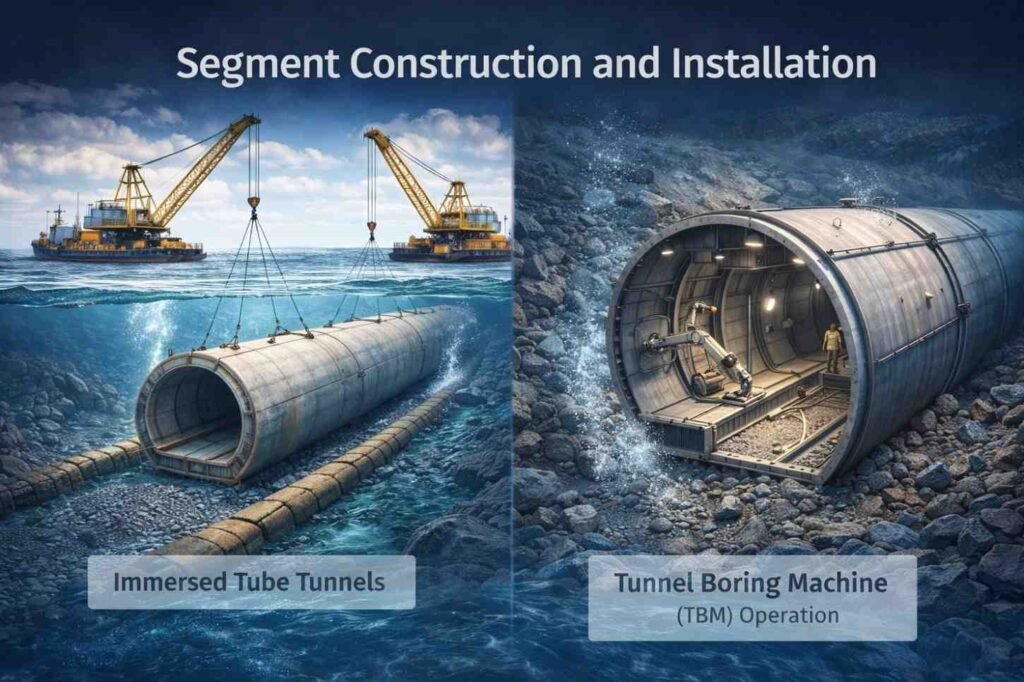
4. Segment Construction and Installation

Segment Construction and Installation

Immersed Tube Assembly

Tunnel segments are usually fabricated in dry docks or shipyards. These sections are:

  • Sealed with temporary bulkheads
  • Floated to the worksite
  • Carefully sunk and joined underwater
  • Permanently sealed and backfilled for stability

Concrete or steel is typically used in construction to withstand both water pressure and loads from above. 

TBM Operation

Tunnel boring machines:

  • Excavates soil or rock while maintaining stability
  • Immediately install precast concrete segments as reinforcement
  • Progress steadily from one end of the tunnel to the other

The TBM shields workers and machinery from collapsing soil and water ingress.

5. Final Structural Works

Once the main tunnel structure is in place:

  • Final sealing against water leaks is applied
  • Internal works like roadbeds, rail tracks, ventilation systems, and lighting are installed
  • Safety systems such as emergency exits and pumps are tested

This stage ensures the tunnel is fully functional and meets all regulatory safety standards.

6. Quality Assurance and Monitoring

Throughout construction:

  • Continuous monitoring ensures alignment, water tightness, and structural performance.
  • Sensors and real‑time data help engineers detect shifts or unexpected conditions early.

Quality control is especially crucial under high hydrostatic pressure environments.
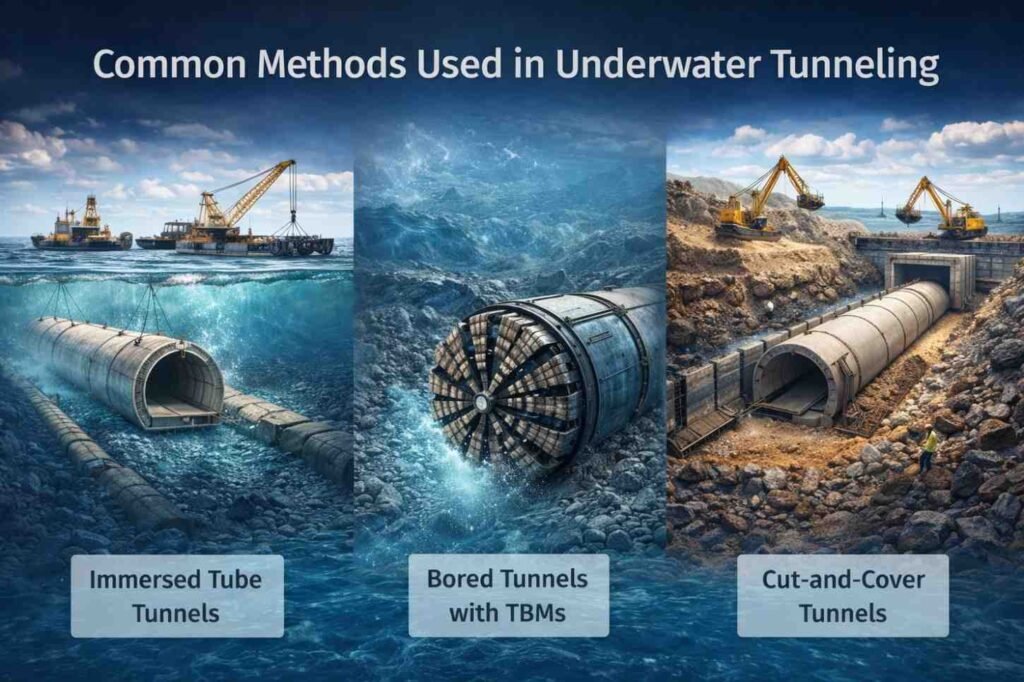
Common Methods Used in Underwater Tunneling

Common Methods Used in Underwater Tunneling

Immersed Tube Tunnels

These tunnels consist of prefabricated sections positioned in a dredged trench, capped with backfill, and connected to create a sealed passageway. This method is particularly efficient for long, moderately deep crossings. 

Bored Tunnels with TBMs

Tunnel Boring Machines are massive cylindrical machines that grind through soil and rock, simultaneously placing support segments behind them. TBMs are chosen when deep tunneling is necessary, and minimal disturbance to the water body is desired above. 

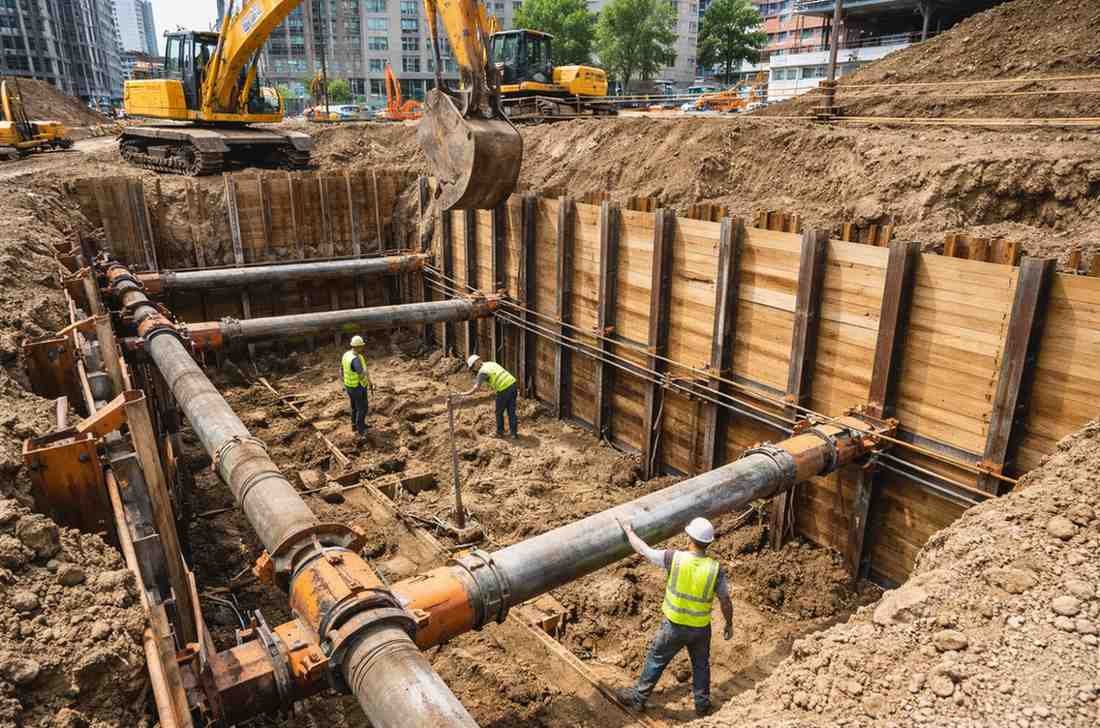
Cut‑and‑Cover Tunnels

Ideal for shallow water approaches, this method digs a trench from above, constructs the tunnel, and then backfills over it. While less common in deep water, it remains practical near shorelines. 

Frequently Asked Questions (FAQs)

1. How long does underwater tunnel construction take?

Construction timelines vary widely. Smaller immersed tube projects may take 3–5 years, while more complex deep‑water tunnels with TBMs can exceed 7–10 years from planning to completion. 

2. What safety measures are used during underwater tunneling?

Engineers employ waterproof linings, continuous monitoring systems, high‑pressure seals, and emergency pumping systems to manage water ingress and structural integrity. 

3. How are tunnel segments kept watertight underwater?

Segments are joined using high‑grade rubber gaskets and seals designed to withstand hydrostatic pressure and prevent leakages in immersed tube tunnels. 

4. Are underwater tunnels more expensive than bridges?

Cost varies by project scale and conditions. While tunnels often cost more up front due to complex engineering and materials, they can offer long‑term savings in maintenance and environmental impact avoidance. 

Conclusion

The process of underwater tunnel construction is one of modern engineering’s most impressive achievements, blending geology, hydrodynamics, architecture, and project management. Every project is customized to its environment and goal, whether it involves building deep-water TBM-driven passageways or meticulously sinking prefabricated parts in an immersed tube tunnel.

These structures not only improve connectivity but also demonstrate how careful planning, innovative techniques, and precise execution can conquer challenging natural barriers below water.


Leave a Reply

Your email address will not be published. Required fields are marked *