 11
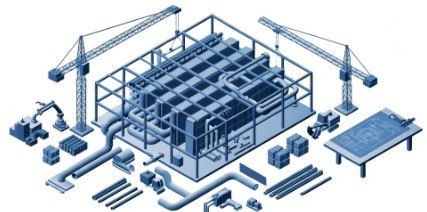
The companies constructing the physical shell of artificial intelligence infrastructure form a short list of firms, and the names on it are the same ones that have dominated heavy industrial construction for decades. When people ask who is building data centers, the honest answer begins with a handful of publicly traded engineering and construction giants, then widens to include specialist trades, prefabrication shops, and electrical contractors whose order books now run years out.
The market is not open to just anyone with a concrete crew, and the barriers are steeper than the headline demand suggests.
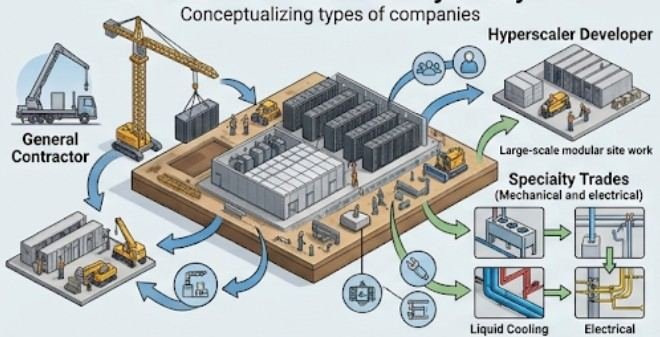
Figuring out who is building data centers requires separating the shell contractors from the fit-out specialists from the developers and hyperscaler self-perform teams that finance the whole operation. Each layer operates on different margins, different risk profiles, and different hiring pipelines.
A general contractor capable of pouring a 300,000 square foot slab and hanging structural steel is not the same outfit that lands the switchgear, cooling loops, and fiber pathways, even when they share a site gate.
The top of the pyramid is concentrated. Companies like Turner Construction, Whiting-Turner, Holder Construction, DPR Construction, Hensel Phelps, Mortenson, Sundt, and the industrial divisions of Bechtel and Kiewit appear repeatedly on award announcements tied to hyperscale and colocation projects.
These firms carry the bonding capacity, safety record, and self-perform labor pools required to deliver a campus on a two year clock. Their data center divisions are separate profit centers with their own estimating teams because the technical demands differ sharply from schools, hospitals, or office towers.
The concentration matters for anyone trying to break in. A subcontractor bidding a shell package against these firms will face prequalification requirements that include audited financials, EMR safety ratings below a specific threshold, and documented experience on mission critical work.
Turner publishes an annual market forecast through its construction market insights page that traces demand curves across sectors, and the data center line has led the nonresidential index for several consecutive years. Reading those forecasts is one way a specialty contractor gauges where the next campus is heading before land is even optioned.
Beyond the national names, regional powerhouses win work through local relationships and speed. A Georgia or Virginia contractor with deep relationships at the county permitting office can move earth faster than an out of state giant willing to pay prevailing wage.
The hyperscalers have learned to blend both, awarding the core shell to a national firm while handing site work, utilities, and smaller packages to regional outfits that know the terrain.
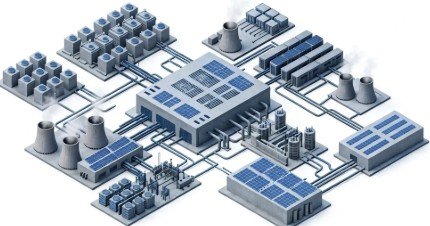
Amazon Web Services, Microsoft, Google, Meta, and Oracle do not simply hand a site to a contractor and wait. Each maintains internal real estate and construction organizations that oversee design standards, procurement, and commissioning, and several have shifted portions of the work toward self-perform or owner controlled construction management.
Microsoft’s newsroom coverage of its infrastructure expansion documents the pace at which the company has announced new regions, and every one of those announcements translates to a construction management team, a general contractor, and a long tail of trade partners.
These owner organizations function like permanent clients. They issue master service agreements, maintain approved vendor lists, and dictate everything from concrete mix design to the color of the security bollards. A firm that lands one hyperscale relationship can ride that pipeline for a decade. A firm that blows a schedule on a single campus will find itself removed from the list faster than it can update its website.
Colocation providers occupy a middle ground. Equinix, Digital Realty, Vantage, QTS, and CyrusOne operate portfolios that require continuous construction of both new campuses and retrofits within live facilities. Their construction managers often come from the general contractor world and carry the same discipline, but the projects tend to be smaller and faster, with tighter coordination around existing customer loads that cannot be interrupted.
Electrical contractors do more of the real work than most observers realize. The mechanical, electrical, and plumbing packages on a modern data center can exceed the value of the structural shell, and the firms that install switchgear, busway, and cooling distribution carry enormous responsibility for the facility actually functioning.
Companies like Rosendin, M.C. Dean, Cupertino Electric, IES Communications, and the mission critical divisions of EMCOR and Comfort Systems appear on project teams across the country. Their schedules determine whether the servers arrive to a working building or a shell with lights on.
Mechanical contractors handle the cooling infrastructure, which in many new builds means liquid cooling loops, CDUs, and chillers sized to densities that would have seemed absurd five years ago.
The shift toward accelerated computing has pushed rack densities from a few kilowatts to well over 100 kilowatts in some halls, and the mechanical design has to accommodate that heat load without a complete rethink of the building every time a new chip generation ships. Contractors that invested early in liquid cooling experience now command premium pricing and get first call on the best projects.
Commissioning agents, testing firms, and controls integrators round out the trade layer. These are smaller companies with specialized certifications, and their availability has become a genuine bottleneck on schedules. A campus can sit substantially complete for months waiting on a commissioning team with an opening.
The scale of the buildout is visible in public numbers. The U.S. Census Bureau’s construction spending data tracks nonresidential categories, and the data center line has grown to a level that influences national GDP figures. Backlog reports from the publicly traded engineering and construction firms show data center work as a rising share of total contract value, which tells you where the smart money in the sector is leaning.
| Layer | Typical Players | Role on a Campus | Contract Size Range
|
|---|---|---|---|
| Owner / Developer | Hyperscalers, colocation REITs | Financing, standards, commissioning oversight | Full project |
| Tier One GC | Turner, Whiting-Turner, Holder, DPR | Shell, structure, site, schedule control | Hundreds of millions |
| Electrical Contractor | Rosendin, M.C. Dean, Cupertino Electric | Power distribution, switchgear, busway | Tens to hundreds of millions |
| Mechanical Contractor | EMCOR, Comfort Systems, regional firms | Cooling loops, chillers, liquid systems | Tens of millions |
| Specialty / Commissioning | Controls integrators, Cx agents | Testing, balancing, controls verification | Single to low double digit millions |
Reading this table horizontally reveals why the question of who is building data centers has no single answer. Each layer has its own competitive set, and the firms rarely overlap across categories. A mechanical contractor does not bid the shell, and a Tier One GC does not self perform switchgear installation on any meaningful scale.

Demand is not the constraint. Labor is. The Associated Builders and Contractors publishes a construction backlog indicator that has shown persistent shortages in the skilled trades, and the data center sector competes for the same electricians, pipefitters, and ironworkers as every other industrial project in the region. Contractors with established crews can pick their jobs. Contractors without them cannot staff the ones they win.
Bonding capacity is the second wall. A hyperscale project can require a performance bond in the nine figures, and only a small pool of sureties will underwrite that exposure for a firm without a long track record on comparable work. Smaller contractors often find themselves limited to packages in the tens of millions even when they have the technical capability to do more.
The third wall is insurance and safety history. Mission critical work carries elevated risk because a schedule slip can trigger liquidated damages measured in daily rates that dwarf the contract margin. Carriers price that risk aggressively, and a contractor with a spotty claims history will struggle to obtain the coverage a hyperscaler requires in its master agreement.
Firms that clear all three walls find themselves in a durable position. The buildout has years left to run, and the same contractors keep appearing on the award lists because the barriers keep out the competition that might otherwise undercut them. Anyone tracking who is building data centers should watch the announced projects rather than the press releases, since the contract awards show up in county records, building permits, and the occasional SEC filing long before they hit a marketing page.
A growing share of the work never happens on site. Modular skid fabrication, prefabricated electrical rooms, and panelized wall systems have moved into climate controlled shops. One that operate like factories rather than job sites.
Contractors with in house prefabrication capability, or close relationships with shops that have it, gain a scheduling edge that translates directly into winning more work. The companies answering who is building data centers now include fabricators that would have been considered suppliers a generation ago.
This shift changes the labor math. A firm that can build a switchgear room in a shop and ship it to the site in one piece needs fewer electricians on the critical path, which reduces the exposure to labor shortages and weather delays.
It also concentrates risk in the shop, where quality control is easier to manage. The contractors investing in this capability are positioning themselves for the next wave of campus construction. Even as the current one fills their books.
The prefabrication trend has not yet displaced the traditional site built approach, and likely will not for the structural shell. Concrete, steel, and earthwork remain stubbornly tied to geography. But inside the shell, the balance is shifting, and the firms that recognize it early. It will hold the schedule advantage that wins the next round of awards.
Anyone trying to read the future of who is building data centers can watch the equipment manufacturers. Transformer lead times, turbine orders, and cooling system backlogs telegraph which projects are moving forward months before the general contractor mobilizes. When a utility announces a new substation to serve a specific parcel, the construction award typically follows within a few quarters. Firms that track those signals can position bids before the open solicitation even appears.
The pattern has held through several buildout cycles. Utilities file interconnection requests, land gets optioned, environmental reviews begin, and then the construction team gets named. Following that sequence gives a clearer picture than any industry conference panel. It works whether the project is a hyperscale campus or a colocation retrofit inside an existing building.
The contractors that understand this pipeline are already staffing up for the next round of awards. And the ones that do not will keep wondering why the same handful of firms keeps showing up on the project signs visible from the interstate.