 11

Drive any interstate corridor outside a mid-size American city and count the cranes. An increasing share of them sit over a flat, graded pad with tilt-up concrete panels stacking up along the fence line, and the reason is straightforward: compute demand has outrun the physical buildings that host it. If you are asking why are they building so many data centers, the honest answer is that the cloud stopped being a metaphor and became real estate.
The load, the square footage, and the electrical service behind every streaming click and every trained model have to live somewhere with slab, steel, and a utility feed, and right now that somewhere is a rural county with cheap power and a friendly board of supervisors.
The construction industry has felt this before with other asset classes: strip malls in the nineties, distribution centers after e-commerce took hold. This cycle differs in one way that matters to anyone who builds. A warehouse can sit half empty and still pay for itself.
A data center built without a secured power allocation is a very expensive concrete box, which is why so many of the projects breaking ground today were structured around a utility interconnect agreement years before the first bulldozer arrived.
The short version is density. Every rack of servers that gets more powerful also gets hotter, and the cooling, electrical, and physical footprint required to keep it alive climbs in lockstep. There is a published ceiling on how much power a single cabinet can draw before liquid cooling replaces air, and that threshold shapes everything downstream, from floor loading to mechanical room sizing.
The 2023 edition of ASHRAE’s thermal guidelines for data processing environments, which the American Society of Heating, Refrigerating and Air-Conditioning Engineers maintains as an industry reference, sets much of the operating envelope that mechanical engineers design toward.
Then there is the demand side, which is less about streaming video and more about model training and inference. Training runs consume power in bursts that would have looked absurd a decade ago, and operators are building capacity ahead of revenue to avoid being the company that cannot honor a contract.
When you parse why are they building so many data centers in a given region, look at the utility rate sheet and the fiber routes before you look at the tax abatements, because power availability drives the decision and the incentives usually follow.

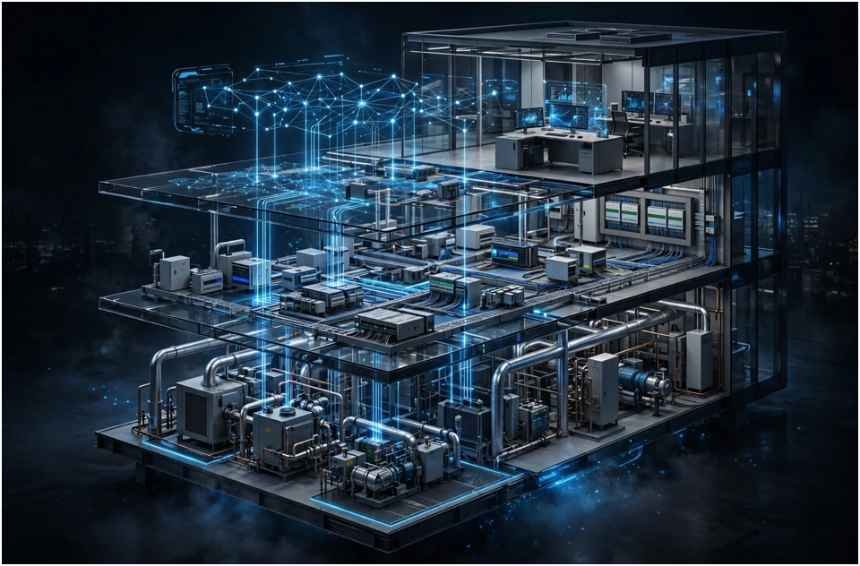
Nothing about a data center shell is exotic. Tilt-up walls, structural steel, a raised floor or a slab-on-grade with overhead tray, redundant mechanical yards. The hard part is the megawatts. A hyperscale campus can draw as much electricity as a small city, and the local grid either has the capacity or it does not.
That is why you see announcements of gigawatt-scale campuses like the one Meta described in an official company announcement on its El Paso data center campus, where the utility arrangement and phased power delivery drove the site selection as much as land cost did.
For contractors, this changes the schedule logic. The building may top out in eighteen months, but the electrical service can take three years to energize. Owners frequently phase construction to match power delivery, which means a builder might frame and skin the first hall while the second hall sits as graded dirt.
The best general contractors on these jobs run a commissioning calendar parallel to the construction calendar from day one, because a shell with no live feed is a warehouse with better security.
Most of the siting calculus reduces to four or five variables that get weighted differently by each operator. Land is rarely the deciding factor, which is why you see farmland disappear outside towns that never attracted industry. The table below reflects the general priorities that show up across public project documentation and utility filings.
| Site Factor | Why It Drives the Decision | Construction Impact
|
|---|---|---|
| Available electrical capacity | Determines whether the campus can be energized at all | Phased builds aligned to utility milestones |
| Water access and cooling method | Shapes mechanical design and local approval risk | Closed-loop or air-cooled systems change the yard layout |
| Fiber proximity | Latency and redundancy for tenant requirements | Early trenching and conduit coordination |
| Zoning and local political climate | Approval timeline can sink a schedule | Pre-application meetings before land closing |
| Labor availability | Trade shortages stretch duration and raise cost | Prefabrication of racks and mechanical skids offsite |
If you want a deeper sense of how the boom concentrated across the country, the U.S. Energy Information Administration tracks the commercial electricity sector that these facilities now dominate in certain states, and the trend lines are public.

Because that is where the power and the land are cheap and the neighbors are few. A rural county with a substation upgrade and a willing economic development office can approve a campus in months rather than years, and the tax revenue from a single facility can rival the rest of the county’s commercial base combined.
This is not a story about corporate benevolence. It is a land and utility arbitrage, and builders who understand it can anticipate where the next pad is going before the announcement hits the local paper.
There is also a construction labor angle. Rural counties rarely have the electrical and mechanical trades available to build a 300,000 square foot facility, so general contractors bring crews in from regional hubs and put them up in extended-stay housing for months.
That dynamic creates its own logistical headaches, from per diem costs to the simple matter of getting enough crane operators on site on the same day.
Anyone who has framed a commercial building will recognize most of the sequence. What differs is the tolerance for failure and the density of systems packed into the shell. A data center has more mechanical and electrical scope per square foot than almost any other building type except perhaps a hospital, and the redundancy requirements mean duplicate equipment everywhere.
Two chillers become four. One switchgear lineup becomes two with automatic transfer between them. Every system has a twin that must be tested independently and then tested in failure mode.
The commissioning phase on these jobs runs longer than most owners expect. You test the electrical distribution under artificial load, usually with rented load banks parked in the yard, and you prove that the cooling system can hold setpoint when a chiller drops offline.
None of that happens quickly, and the contractor carries the schedule risk until every sequence is signed off. Mechanical and electrical commissioning on a large facility can run four to six months on its own, and that is before the tenant’s IT team begins its own acceptance testing.
Structural requirements push the same direction. Floor loading on a fully populated server hall can exceed what a standard office slab is designed for, and the vibration criteria for sensitive equipment add another layer.
Engineers and construction teams must coordinate and finalize fabrication details for embedded conduit, seismic bracing, and overhead supports in the model before crews pour the concrete. Otherwise, adding a conduit run would require cutting into the finished slab and creating an expensive change order.
Because capacity is bought forward, not backward. Operators lease space years in advance to secure pricing and availability, so a facility that looks underutilized today may be fully committed on paper for tenants who have not yet moved in equipment. The same dynamic drove speculative office construction in growing metros for decades: the shell gets built, the tenant fills it on their own timeline, and the building trades collect their money either way.
That said, the vacancy picture is not uniform. Older facilities with obsolete power density and inefficient cooling lose tenants to newer campuses, which is why some markets show healthy absorption while others have aging inventory nobody wants to lease.
When you ask why are they building so many data centers and simultaneously closing some, the answer is that the product being built today is not the same product built in 2008. Power per rack, cooling method, and physical security all moved forward, and the older stock cannot compete.
Flat ground, good drainage, and low acquisition cost. A developer looking at a few hundred acres of row crop outside a town with a substation can assemble a site faster than almost any urban infill option, and the grading is straightforward.
What complicates the picture is local resistance, which has grown as more communities experience the water and noise questions that come with large mechanical yards running around the clock.
Some counties have started pushing back on water use, particularly in drought-prone regions, and operators have responded with closed-loop cooling designs that consume far less. The construction consequence is that mechanical yard footprints grow and the plumbing scope changes, which affects both cost and schedule.
A builder pricing a job in a water-constrained county should expect a different mechanical package than the same building in the Southeast.
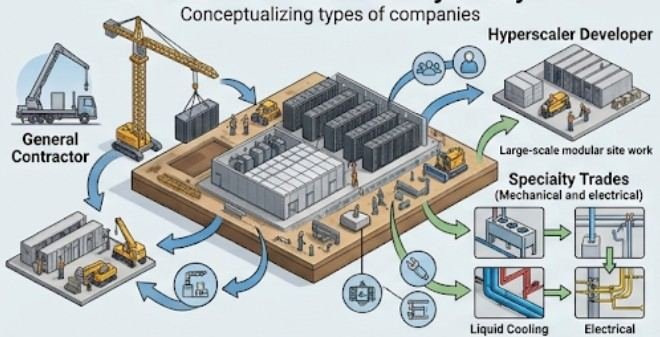
A short list of national general contractors dominates the hyperscale market, but the majority of the work filters down through regional firms, specialty electrical and mechanical subcontractors, and site work crews who never make the announcement photo. Explore who is building data centers across today’s expanding infrastructure market.
The contractor list is narrower than the building count suggests, and that concentration means a handful of firms control the labor pipeline for the largest projects. When those firms get booked out, smaller operators and colocation providers feel the squeeze on schedule and pricing.
For a regional builder looking at this market, the entry point is usually one of the specialty scopes rather than the full campus. Site work, structural concrete, or the interior build-out of a powered shell are all realistic toeholds, and a completed data center project on a portfolio opens the next conversation.
The learning curve is real, though. The specifications are long, the owner’s representatives are technical, and the documentation requirements are stricter than most commercial work.
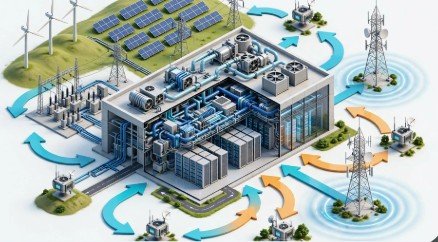
Every projection about the pace of construction assumes the utilities can deliver. They cannot always. Interconnection queues in several grid regions now stretch past the end of the decade. Some operators have turned to on-site generation, long-term power purchase agreements, or nuclear arrangements to secure supply.
That shift changes the construction scope again. Because a facility with on-site generation needs fuel handling, switchgear, and emissions controls that a grid-tied building never required. Builders who track utility interconnection timelines alongside their bid calendars will see the next wave of projects coming. The wave after that will likely be defined less by how many data centers get built. And more by how much power the grid can actually deliver to them.