 11

The short answer to what is a building automation system is this: it is the networked control layer that runs the mechanical, electrical, and plumbing equipment inside a commercial property without a human standing at every switch. A building automation system, or BAS, ties chillers, air handlers, boilers, lighting circuits, and meters into one supervised network so that setpoints, schedules, and alarms are managed from a workstation instead of a clipboard.
Most owners only confront the question of what is a building automation system after a contractor hands them a submittal book, and by then the specification is already frozen. Understanding the architecture before that meeting is the difference between a system that serves the building for fifteen years and one that gets bypassed within three.
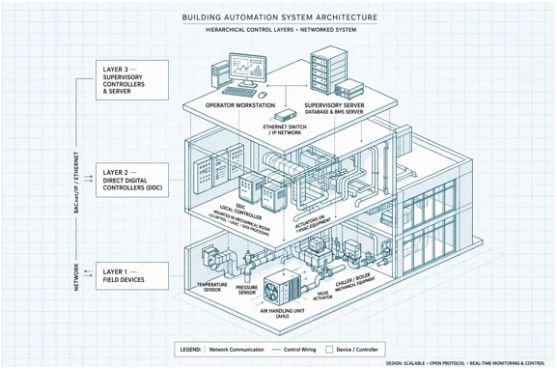
Strip away the acronyms and a BAS is a hierarchy of controllers that read sensors and command equipment. Field devices at the bottom measure temperature, pressure, airflow, and current. Those signals travel to direct digital controllers mounted in mechanical rooms, and those controllers report upward to a supervisory layer that stores trends and presents graphics to the operator.
The U.S. Department of Energy frames these systems around their energy management function, but the operational reality is broader. A BAS is the only place in a facility where you can see every piece of equipment at once, and it is the only system that can prove whether a rooftop unit was actually running at 2 a.m. when nobody was in the building.
When a contractor asks what is a building automation system supposed to do on a given project, the answer should come from the owner’s operating plan rather than a generic template. Practical physical details—such as how tall is a story in a building or the total clearance volume—matter just as much as space usage. A distribution warehouse with eight rooftop units and no occupancy after 6 p.m. needs scheduling and trending, not a laboratory-grade control narrative.
A hospital or a lab with pressurization relationships and redundancy requirements needs far more instrumentation and far more programming discipline. The definition of the system is set by the sequence of operations, which is the written document describing exactly how each piece of equipment responds to each condition.
Design teams often treat controls as a division 25 or division 23 line item that gets delegated to the mechanical contractor, and that delegation is where budgets quietly expand. The general contractor carries the schedule risk while the controls subcontractor carries the technical risk, and neither party has much incentive to push a detailed points list through design review.
The result is a system specified by a single sentence such as “provide a complete DDC control system,” which means the installing vendor defines scope after award. Owners who understand what is a building automation system early in preconstruction can force a point count, an open protocol requirement, and a training obligation into the bid documents where they belong.
The National Institute of Standards and Technology has published a framework specifically addressing cybersecurity for building automation systems, and that document alone explains why the question of what is a building automation system can no longer be answered without discussing network segmentation.
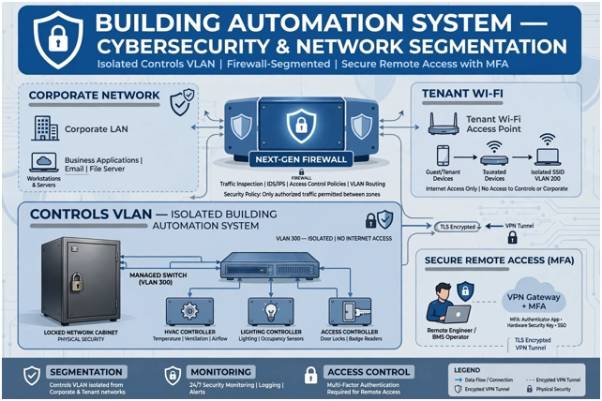
Once a BAS sits on the same flat network as tenant Wi-Fi and point-of-sale terminals, every controller becomes an entry point. Isolation through a dedicated controls VLAN and a managed firewall is not an advanced configuration in 2025; it is the baseline that insurers and IT departments now expect to see in the turnover package.
The hardware stack breaks into four functional layers, and knowing which layer a line item belongs to prevents the most common change order disputes.
A fifth layer, often ignored during pricing, is the operator interface itself. Graphics that mirror the actual mechanical layout save an enormous amount of troubleshooting time, and a system delivered with generic point blocks instead of equipment graphics will cost the maintenance staff hours on every service call. When scoping what is a building automation system for a specific facility, insist that the graphics package be priced as a deliverable rather than assumed.
| Delivery Model | How Controls Are Procured | Owner Flexibility | Typical Risk
|
|---|---|---|---|
| Proprietary single-source | One manufacturer provides hardware, software, and service under a sole-source agreement | Low; future work tied to that vendor | Locked-in service pricing and limited competitive bidding |
| Open protocol specified | Design team mandates BACnet or another open standard with a published point schedule | Moderate to high; multiple vendors can service the system | Integration gaps between vendors require commissioning scrutiny |
| Owner-managed front end | Owner purchases the supervisory software directly and licenses contractors to integrate | High; the owner controls the data and the vendor list | Requires in-house technical staff or a retained integrator |
| Controls as a service | Vendor retains ownership of the head end and charges a subscription | Low to moderate; depends on contract exit terms | Data portability and exit costs if the relationship ends |
Three documents decide the outcome of a controls package, and all three should exist before the job goes out for pricing. The first is the sequence of operations, written in plain language describing equipment response to conditions. The second is the points list, a spreadsheet counting every input and output the system must handle, because that count drives controller quantity and cost far more than square footage does. The third is the network riser diagram showing how controllers connect to the head end and how the BAS network relates to the owner’s IT infrastructure.
A fourth document, the commissioning plan, should name the controls commissioning agent and define the functional performance tests that will be run before acceptance. The ASHRAE standards library is where design teams find the ventilation and indoor air quality criteria that a control sequence must satisfy, and referencing those standards by number in the specification removes ambiguity about what the system is expected to maintain. Owners who ask what is a building automation system worth paying for should look at the commissioning budget, because an untested system is a system that will be manually overridden within the first year.
Interoperability is where marketing language and field reality diverge most sharply. A vendor can claim BACnet compliance and still deliver a system where the scheduling function only works through proprietary software, which means the owner cannot run the building without a service contract. The practical test is to demand, in writing, that scheduling, trending, alarm routing, and point override all be available through the open protocol interface, and then to verify it during functional testing with the vendor’s laptop disconnected.
Legacy equipment complicates the picture on renovation projects, where a new head end must talk to controllers installed a decade or two earlier. Gateways that translate Modbus or older proprietary protocols into BACnet exist and generally work, but each gateway adds a failure point and a programming layer. When an owner asks what is a building automation system going to cost on a retrofit, the honest answer depends on how much of the existing field hardware can be retained, and that question requires a site survey rather than a phone call.
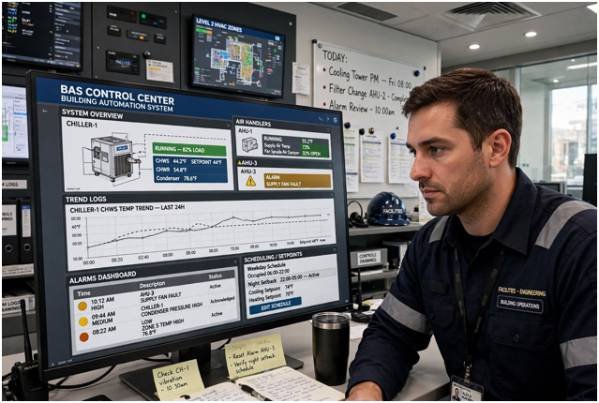
Day to day, the system handles four recurring jobs. It executes occupancy schedules so equipment runs when the building is occupied and shuts down when it is not. It maintains setpoints by modulating valves, dampers, and variable frequency drives. It generates alarms when conditions drift outside defined limits, and it archives trend data that supports maintenance planning and utility bill analysis. A system that does all four reliably is doing its job. A system that does the first three and leaves the fourth to a standalone spreadsheet is only half installed.
Alarm management deserves its own attention because a flood of nuisance alarms trains operators to ignore the entire alert system. Good specifications include alarm classes, thresholds, and a routing scheme so that critical alarms go to the on-call technician while routine notifications wait for business hours. The question of what is a building automation system actually delivering to a maintenance department gets answered by how many useful alarms it produces per week, not by how many points it monitors.
Controls networks are increasingly targeted because they sit at the intersection of physical access and digital infrastructure. A compromised BAS can alter setpoints, disable alarms, or provide a foothold into a corporate network. The NIST framework cited earlier recommends asset inventory, network segmentation, and controlled remote access, and those three measures cover most of the practical exposure. Remote access in particular should never be a vendor-supplied modem left connected indefinitely; it should require smart-tech securely-pass protocols through a documented, monitored, and revocable connection with multi-factor authentication.
Password practices on BAS head ends remain shockingly poor across much of the installed base, with factory defaults and shared technician accounts surviving for years after turnover. A specification clause requiring unique named accounts, mandatory password changes, and removal of all default credentials at substantial completion is inexpensive to write and difficult to argue against. Owners reviewing what is a building automation system handover should insist on a credential schedule delivered with the as-built documents.
The training obligation is the most commonly cut item during value engineering, and cutting it is a false economy. A controls system is only as useful as the operator’s ability to navigate it, and a two-day training session covering graphics, scheduling, alarms, and trend analysis costs a small fraction of the annual service contract it displaces. The turnover package should include as-built network risers, controller addressing schedules, the final sequence of operations with all field revisions marked, a points list matching the installed system, and recorded training sessions that future staff can review.
Warranty terms also deserve scrutiny, because a one-year warranty that starts at substantial completion and expires before the first full cooling season has finished tells you little about the system’s real reliability. Owners who understand what is a building automation system lifecycle costs look like usually negotiate a warranty period tied to verified performance across both heating and cooling seasons, paid for out of the contingency rather than the controls budget.
Controls pricing scales with point count, equipment diversity, programming complexity, and integration requirements far more than with building area. A simple warehouse with packaged rooftop units and a scheduling-only requirement can be delivered for a modest per-point cost, while a laboratory with pressurization control, fume hood monitoring, and validated sequences can run several times higher per point because every input requires documented response verification. Owners comparing bids should normalize on the points list rather than the total number, since a low bid with a stripped scope is not a low price.
Lifecycle planning matters as much as first cost. Head end servers and operator workstations generally need replacement on a shorter cycle than the field controllers, which often survive fifteen years or more. Budgeting for a head end refresh every seven to ten years, along with periodic software updates mandated by the manufacturer, keeps the system supportable without a wholesale replacement. The General Services Administration publishes design and construction guidance for federally owned facilities that includes controls and energy management considerations, and it is a useful public reference for owners drafting their own standards.
The failures repeat across nearly every project type. Schedules get overridden manually and never restored. Sensors drift and nobody recalibrates them. Trend logs fill a server that nobody backs up. Graphics get built for the installing technician rather than the building operator. Sequences get written by people who never walked the mechanical room. Each of these is a scoping and handover problem rather than a technology problem, and each is preventable through specification language that assigns responsibility clearly.
The single most effective preventive measure is a functional performance test witnessed by someone representing the owner’s interest, with pass and fail criteria written into the commissioning plan before the equipment arrives on site. A technician demonstrating that a schedule executes, that an alarm routes correctly, and that a trend graphic is readable in the operator interface takes hours rather than days, and it catches the majority of defects that would otherwise surface during the first uncomfortable week of the cooling season.
Owners who treat controls as a commodity purchase will get commodity results, and the building will be run by workarounds until the next renovation. The more durable approach is to define the sequence of operations, count the points, mandate open access, verify performance, and train the people who will actually touch the head end. That standard, applied consistently across a portfolio, produces buildings that operators can run confidently without a vendor on speed dial, and it turns what is a building automation system from a line item in the submittal book into the operating record of the property.