 11
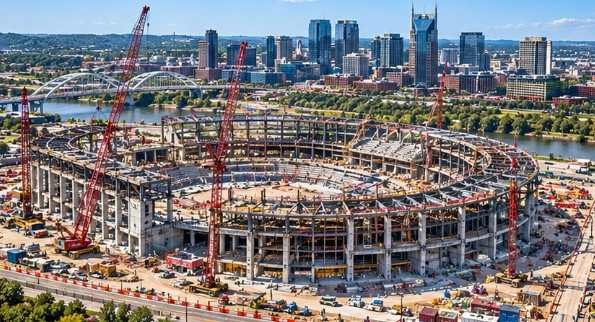
Yes, the Tennessee Titans are building a new stadium, and the answer to are the Tennessee Titans building a new stadium stops being a rumor the moment you look at the demolition permits and the lease termination paperwork. The old Nissan Stadium opened in 1999, and the team’s lease with the Metro Nashville Sports Authority ran through 2039.
That lease is now terminated by mutual agreement, the old building is coming down, and a roughly $2.1 billion domed venue is rising on the same east bank footprint along the Cumberland River. This is not a renovation story with a fresh coat of paint. It is a full teardown and rebuild, financed through a mix of public bonds, team equity, and a set of stadium-specific revenue streams that construction contractors should understand before they bid on any piece of the work.
The short answer to are the Tennessee Titans building a new stadium is that the project broke ground in 2024 and is targeting a 2027 opening. The Nashville Metropolitan Council approved the deal in December 2022, and the financing structure was locked in shortly after. The new building carries a projected price tag north of $2 billion, which makes it one of the largest private-public construction projects ever undertaken in Tennessee.
The Titans are carrying roughly $840 million in team and NFL contributions, the state of Tennessee committed $500 million through a bond allocation signed into law in 2023, and Metro Nashville issued $760 million in revenue bonds backed by the stadium’s own tax receipts and sales taxes generated on site.
For anyone tracking the question of are the Tennessee Titans building a new stadium, the project is now a moving construction site rather than a planning exercise. Stewart Creek, which runs along the eastern edge of the parcel, required rerouting and culvert work before the structural steel could go up. That kind of civil infrastructure sequencing is the part of stadium construction that rarely makes the news, and it is also the part that eats the early months of any large venue schedule.
The renovation alternative was priced and rejected. A 2022 study commissioned by the Sports Authority and prepared with input from the Titans put a full renovation of Nissan Stadium in the range of $1.8 billion to $2 billion, which is close enough to new construction that the council chose to build fresh.
The original building had reached the end of its useful service life on several fronts: the concrete bowl was showing age-related deterioration, the seating layout could not accommodate modern concourse and club-level demands, and the building had no roof, which limited Nashville’s ability to host Super Bowls, Final Fours, and other neutral-site events that drive the economic case for public investment.
The Metro Nashville Sports Authority published the full negotiation record and the term sheet on its official Sports Authority page, and the numbers in that record are what contractors and analysts should treat as the baseline. The old stadium’s demolition contract was awarded separately from the new construction, and the sequence matters.
The new building is being constructed on a shifted footprint, partially overlapping the old parking lots, which allowed the Titans to keep playing at Nissan Stadium through the 2024 season while the new structure went up next door.
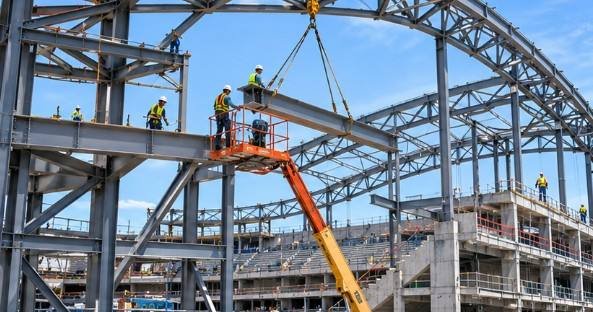
The construction sequence on the east bank is the part of are the Tennessee Titans building a new stadium that matters most to trade contractors. The Cumberland River borders the construction site to the west, while Interstate 24 runs along its eastern edge, leaving limited space for equipment and materials and requiring crews to schedule deliveries by the hour.
The general contractor team is building the structural frame, the roof structure, and the mechanical systems in a phased overlap rather than a straight line, because the domed roof cannot wait for the bowl to be complete.
The dome itself is a cable-supported structure with an ETFE roof system, the same family of material used on the Minnesota Vikings’ U.S. Bank Stadium and several European soccer grounds. ETFE is a polymer film stretched over a steel frame, and it weighs a fraction of traditional roof decking while letting daylight through.
The tradeoff is that the pneumatic cushions require continuous air handling, which puts the roof mechanical package on the critical path for commissioning. If the roof pressurization system is not commissioned before the seating bowl is finished, the interior finish schedule stalls. That dependency is why the stadium’s mechanical, electrical, and plumbing trades are working under a fast-track model with early equipment procurement.
| Project Element | Detail | Status as of 2026
|
|---|---|---|
| Total budget | Approximately $2.1 billion | Locked via council approval |
| Public contribution | $1.26 billion (state and Metro combined) | Bonds issued |
| Team and NFL contribution | Approximately $840 million | Committed |
| Seat count | Roughly 60,000, expandable | Design complete |
| Roof type | Cable-supported ETFE dome | Under construction |
| Target opening | 2027 NFL season | On schedule per team |
| Old stadium | Nissan Stadium, demolished after 2024 season | Demolition complete |
The financing structure behind are the Tennessee Titans building a new stadium is what separates this project from a typical private development. Metro Nashville issued revenue bonds instead of general obligation bonds, allowing tax revenue from the stadium district to cover the debt payments without requiring a broad property tax increase.
Similar questions about construction financing and government approvals arise when examining whether Trump is building a triumphal arch in Washington, DC, where proposed monument development involves additional regulatory and funding considerations.
The state’s $500 million contribution came through a single appropriations bill, and the Tennessee Comptroller’s office has published guidance on how those funds are disbursed and audited. Contractors working on publicly funded portions of the project should expect the same prevailing wage and reporting requirements that apply to any Tennessee public works job, and the payment schedule runs through the Sports Authority rather than directly through the team.
For subcontractors, this means project managers divide the bid package into publicly and privately funded portions, with each funding category requiring different paperwork depending on the scope of work. Site work, infrastructure, and the public plaza fall under the public side.
The interior club spaces, the team facilities, and the premium seating build-out fall under the private side. Bidders who assume a single contract structure will find themselves reworking their proposals at the prequalification stage.
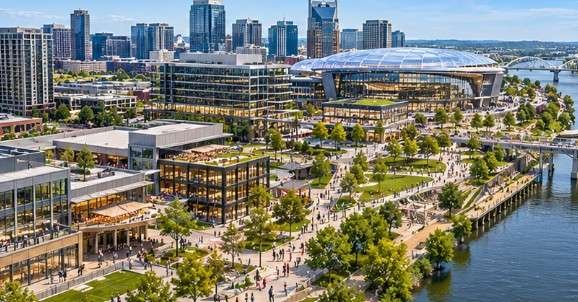
The building program is not just a football bowl. The design includes a 12,000 square foot community space, a dedicated amphitheater and plaza area on the north end, and a mixed-use development zone on the surrounding 66 acres that the Titans control through a separate development entity.
The surrounding development could deliver long-term returns on public investment by generating rental income throughout the year, while the stadium itself earns revenue on roughly 20 event days annually.
The Titans released renderings and program details through their official new stadium portal, and the documents show a lower bowl designed for conversion between football and soccer configurations, plus a raised field level that allows for dirt and ice surfaces for motocross and hockey events.
That convertible field structure is one of the more technically demanding pieces of the build, because the field tray system requires precise hydraulic and drainage integration with the structural slab below.
The economic case for are the Tennessee Titans building a new stadium has been challenged by independent researchers, and the challenge deserves airtime. A widely cited body of work from economists at the University of Chicago and elsewhere has found that stadium construction rarely delivers the broad economic multiplier that team and city projections claim.
The Brookings Institution published an analysis arguing that public spending on sports facilities typically redirects consumer spending rather than creating new economic activity, and that the jobs created are largely temporary construction positions. You can read the Brookings case in its stadium financing analysis.
Nashville’s counterargument rests on the specific structure of this deal rather than on generic multipliers. Tax revenue from the district backs the bonds, while the state provides a one-time contribution instead of an ongoing subsidy.
Developers are also transforming the surrounding 66 acres into taxable mixed-use properties on a previously contaminated industrial riverfront site. However, the district’s full development will take about a decade, so stakeholders cannot determine whether this economic argument holds until long after 2027.
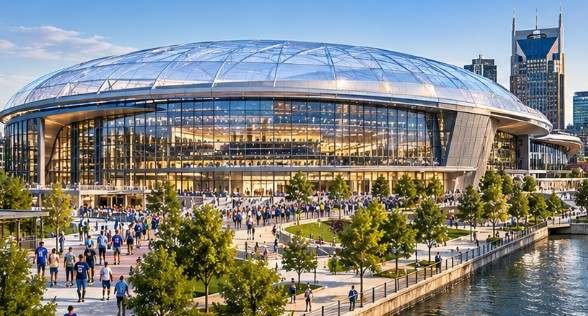
The Titans have publicly targeted the 2027 NFL season for opening, and the construction schedule published by the team’s development partner reflects that target. The critical milestones in the rearview mirror are site demolition, utility relocation, and the structural steel topping out. The milestones still ahead are roof installation and pressurization, interior fit-out, field tray commissioning, and the certification process required before the building can host a public event.
Anyone still asking are the Tennessee Titans building a new stadium in 2026 is working from stale information. The project has reached the point of no return. Officials have sold the bonds, and construction crews have erected the steel framework. The biggest remaining concern is the construction schedule, as failures during mechanical and roof system commissioning typically cause more delays on projects of this scale than structural framing issues.
Are the Tennessee Titans building a new stadium is a question with a broader answer than a single venue. The east bank project is the anchor for a multi-phase riverfront redevelopment that includes residential towers, office space, and a new pedestrian bridge connection to downtown.
The Titans’ development arm is master planning the surrounding blocks, and those blocks will generate years of construction work after the stadium itself is finished. Contractors who want a piece of that pipeline should be tracking the Metro Planning Department’s entitlement filings rather than waiting for public bid notices, because much of the surrounding development is private work moving through the planning process quietly.
The stadium is also resetting Nashville’s event infrastructure competition with other mid-market cities. A domed, 60,000 seat venue in a city with an established hospitality sector changes the calculus for Super Bowl and Final Four bids, and the city’s tourism board has already signaled it will pursue both. Those bids are contingent on the building opening on time, which puts the commissioning schedule on the critical path for the city’s economic development office as much as for the team.
Are the Tennessee Titans building a new stadium gets a definitive yes, and the construction reality behind that yes involves a fixed-price public-private structure, an ETFE domed roof on a fast-track mechanical schedule, and a surrounding 66-acre development that will outlast the building itself.
The public money is committed, the old stadium is gone, and the 2027 opening date is the number that matters. For anyone in the construction and development trades. The more useful question has moved past whether the Titans are building and into which of the surrounding parcels will break ground first. Because that is where the next decade of work sits.