 11

Determining how many people died building famous bridges is difficult because historical records are incomplete. During the nineteenth century, construction companies rarely maintained reliable fatality records.
Available information comes from company payrolls, coroner reports, contracts, and newspaper archives. However, these sources often exclude workers who died after leaving construction sites.
As a result, commonly reported death tolls may underestimate the actual number of fatalities. Historical accounts frequently provide minimum figures rather than complete totals.
Understanding how many people died building famous bridges requires examining each project’s records separately. Some figures are well documented, while others rely on estimates or historical claims.
This article examines construction fatalities across famous bridges and the challenges of recording them accurately. It also highlights important lessons for modern contractors, engineers, project managers, and construction safety professionals.
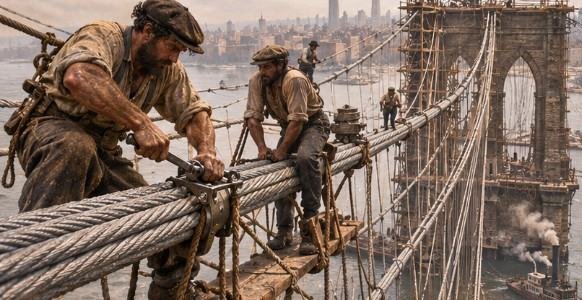
The Brooklyn Bridge number is the one most often misquoted, usually by people eager for a dramatic story. The commonly cited figure of two dozen deaths is traceable to Washington Roebling’s own often loose accounting and to later retellings that treated every injury-related death as a hard construction statistic.
What the record actually shows is a small set of confirmed fatalities from accidents during construction, a mortality count among caisson workers that neither Roebling nor the New York Bridge Company ever fully tracked, and a long tail of men who were carried off after the work finished.
The compressed-air illness from the caissons, the bends, debilitated dozens of workers and crippled Washington Roebling himself, though that is a topic of its own. The number that gets repeated is small because it counts only deaths directly and immediately attributable to the bridge work as a category, and it does not clean up the men who never fully recovered.
Emily Warren Roebling’s role in pushing the project to completion is well documented by the National Park Service without pretending the human cost was tidy.
The Golden Gate Bridge has one of the most accurately documented construction death tolls in the United States. Eleven workers died during construction, according to official project records.
The bridge’s safety measures were unusually advanced for the 1930s. Its construction helped establish the importance of fall protection in major infrastructure projects.
However, ten workers died in February 1937 when a scaffolding platform collapsed through the safety net below. Before this tragedy, the net had successfully saved nineteen workers from fatal falls.
The disaster demonstrated that safety nets alone could not eliminate construction risks. Effective worker protection requires multiple safety measures, regular inspections, and reliable equipment.
The Eads Bridge across the Mississippi in St. Louis set a documented toll of around a dozen during its caisson phase, and it set a precedent too: the bends killed men who were never counted on the project ledger because they died at home weeks later.
The caisson records of the period are among the eeriest primary documents in American civil engineering, and the National Institute for Occupational Safety and Health still publishes guidance on decompression hazards that descends directly from what happened under the Missouri riverbed.
The Quebec Bridge has the grimmest count that any well-known span carries, with roughly eighty-eight documented deaths across two failures. The first collapse came in 1907, the second in 1916 when the central span dropped into the St. Lawrence during the rebuild.
A Royal Commission inquiry into the first collapse laid the blame on design miscalculation and on an engineer who ignored warnings, and the disaster is still a mandatory case study in engineering programs.
The table below is a working reference, not a complete census. Counts are documented minimums where the source is clear and labeled as contested where the record is not.
| Bridge | Year Completed | Documented Fatalities | Record Quality
|
|---|---|---|---|
| Brooklyn Bridge | 1883 | Contested, commonly cited at 20 or more | Incomplete, no unified project ledger |
| Eads Bridge | 1874 | Around 12 from caisson illness alone | Partial, caisson death records fragmented |
| Golden Gate Bridge | 1937 | 11 | Well documented by the owning district |
| Quebec Bridge | 1919 | Approximately 88 across two collapses | Detailed, Royal Commission inquiry on file |
| Forth Bridge | 1890 | Around 73, with additional later estimates | Company records, contested totals |
| Verrazzano-Narrows | 1964 | 3 | Documented by project records |
| Millau Viaduct | 2004 | 0 among project workers, with a small number of indirect deaths tracked separately | Modern industrial reporting |
Any honest answer to how many people died building famous bridges has to sit inside a table like this, where the number of deaths and the quality of the record are stated side by side, and the reader can see that the count and the confidence are not the same thing.
The bridges that killed the most workers are not the bridges with the worst safety records. They are the bridges whose owners happened to keep the best paperwork.
Three habits in the record suppress the count. The first is the short bill of mortality, where a company counted only men who died on site within an arbitrary window and dropped everyone who died at a hospital or in a boarding house afterward.
The second is contract language, where the general contractor’s payroll absorbed only the men they had hired, and the subcontractor’s men vanished when the subcontractor went bankrupt. The third is geographic, and it is the largest: the masons, riveters, and laborers whose names appear nowhere were often recent immigrants whose families could not afford a legal claim and whose deaths were recorded in a parish register with no connection to the project at all.
Modern projects are not exempt from the paperwork problem, they have just moved it. The United States Bureau of Labor Statistics tracks occupational fatalities through the Census of Fatal Occupational Injuries, and the reporting categories treat bridge construction as a subset of heavy civil work, which means a bridge death can disappear into a broader category and never reach the bridge’s own public tally.
A project can report zero fatalities of its own while the county coroner records a death on a scaffolding failure twelve hours after the crew signed out.
The record quality gap is the whole problem in miniature. When you ask how many people died building famous bridges, what you are really asking is who was counting and what they were incentivized to leave out.
A contractor looking at a historic toll is looking at a design failure or a management failure dressed up as bad luck, and the trade has been slow to admit which is which. The Golden Gate net saved lives because somebody paid for it. The Quebec collapse killed men because somebody overruled a load calculation. Neither outcome was fated, and both are the visible end of decisions made months or years earlier by people with names.
The shift in modern practice is not a moral one, it is a systems one, and it lives in the owner’s contract documents rather than in the foreman’s toolbox. The OSHA fall protection standard for construction puts the duty on the employer to provide the system, not on the worker to be careful, and that is the single largest change in the fatality math of the last half century.

The practical lesson from every bridge in that table is that the death toll is a function of the control layer, and the control layer is ordered:
The best-known bridge projects of the modern era show the effect of these layers in a way the historic spans never could. The Millau Viaduct in France was completed in 2004 with no deaths among the construction workforce, a result its project team attributed to design-stage planning that pushed fabrication to the ground and limited work at height. That outcome was not luck, it was a contract decision made years before the first pier went in.
People searching how many people died building famous bridges often want reliable historical facts. Engineers, safety officers, contractors, and workers’ families need accurate death tolls supported by credible records. Every reported figure should include its source and the period covered.
Historical bridge construction fatalities are often difficult to calculate precisely. The Brooklyn Bridge’s actual death toll may exceed commonly reported figures when caisson-related deaths are included. Similar uncertainties surround the Eads Bridge and Forth Bridge.
In contrast, the Golden Gate and Verrazzano-Narrows bridges have more reliable fatality records. Improved documentation during their construction helped preserve accurate information about worker deaths.
Modern bridges are not automatically safer, but construction safety standards and reporting systems have improved significantly. Accurate incident records help identify hazards, prevent accidents, and strengthen workplace accountability.
Understanding how many people died building famous bridges highlights the importance of transparent safety reporting. Construction companies must document every workplace fatality, including deaths linked to injuries that occur after workers leave the site. Better recordkeeping helps protect future workers and prevents historical mistakes from being repeated.