 11
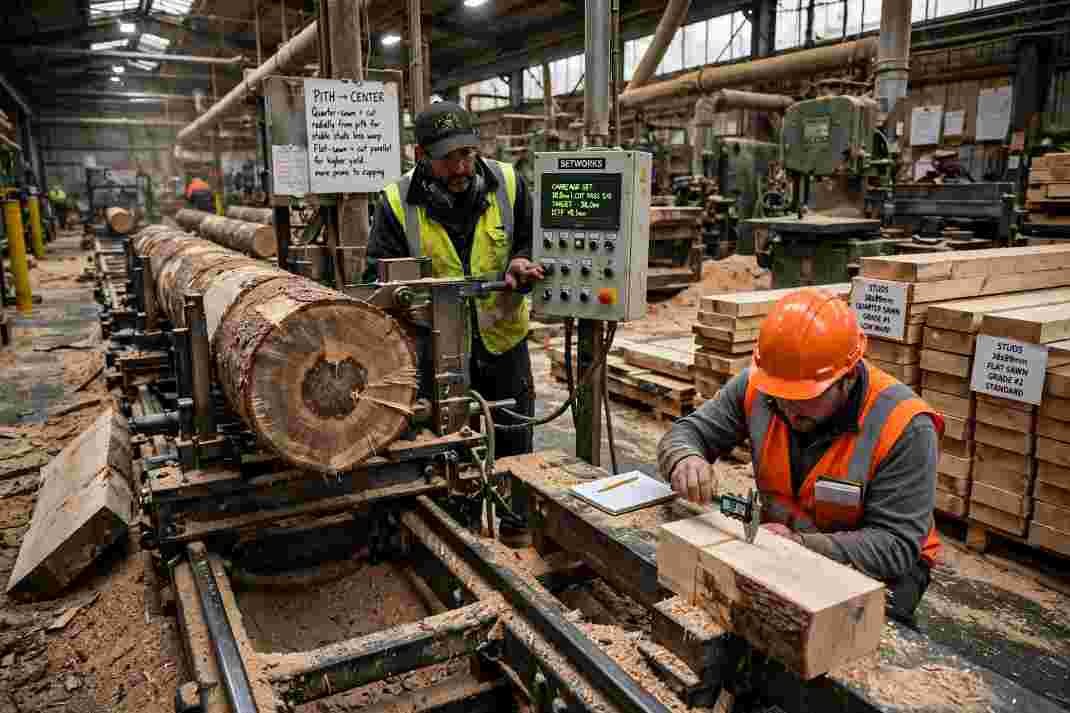
Building timber is made by felling a log, bucking it to mill length, running it through a headrig or bandsaw to produce a cant, resawing that cant into dimensioned boards, edging and trimming the pieces to nominal size, kiln drying the stock to a target moisture content, planing it to surfaced dimensions, and then grading it under a visual or machine rule before it ships to a yard or truss plant.
Every one of those steps leaves a mark on the board you eventually nail into a wall, and the answer to how is building timber made is really an answer about which of those steps went right and which got rushed. The sawmill decides the grade long before the framer ever touches the material, and the difference between a straight stud and a corkscrewed one usually traces back to how the log was oriented on the carriage and how carefully the kiln schedule was followed.
Timber production starts in the woods, not the mill. The species chosen depends on the structural role the lumber will play, and specifiers generally sort softwoods into groups by strength and availability, with Douglas fir, southern yellow pine, spruce pine fir, and hem fir covering most of the residential framing market in North America.
Hardwoods like oak and maple move through a different channel, mostly for cabinetry, flooring, and millwork, because their density and drying behavior make them awkward for commodity framing. Understanding how is building timber made begins with the recognition that species selection is a structural decision disguised as a purchasing decision.
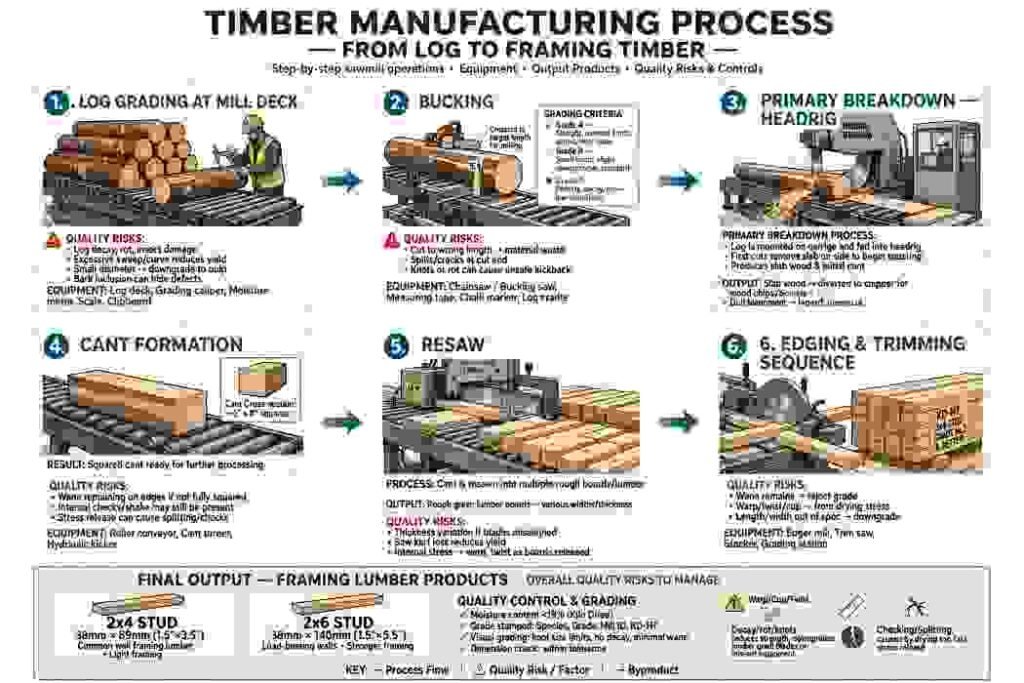
Log grading happens at the landing or the mill deck. A scaler evaluates diameter, taper, sweep, and defect volume, then assigns a grade that determines what the log can realistically yield. A log with heavy sweep may still produce good short boards but will never yield long structural joists, and a mill that ignores this wastes carriage time chasing a cut the log cannot deliver. The USDA Forest Service research library publishes extensive material on log scaling and yield estimation for anyone who wants the underlying math.
The sawyer’s first decision on the carriage is how to rotate the log relative to the saw line. Cutting parallel to the pith produces flat grain with a predictable shrinkage pattern, while quarter sawing produces vertical grain that is more dimensionally stable but slower to produce and lower in yield.
For framing lumber the mill generally favors volume over stability, which is why studs cup and twist the way they do. Anyone who has sorted a bunk of 2x4s on a job site has seen the practical consequence of that tradeoff, and it is a direct artifact of how is building timber made at the headrig.
The cutting sequence converts a round log into rectangular stock through a series of passes, and the equipment used determines both the surface quality and the production rate. A headrig with a carriage handles large logs one at a time, while a scragg mill or a twin band processes smaller logs at higher speed. The first passes remove slab and open a face, the middle passes establish the cant, and the final passes resaw that cant into boards of the target thickness.
| Stage | Equipment | Output | Quality Risk
|
|---|---|---|---|
| Bucking | Chain or circle saw | Logs cut to mill length | End splits from dull chain |
| Primary breakdown | Headrig, twin band, or scragg | Slabs and an opened face | Wane from poor log placement |
| Cant formation | Carriage with setworks | Four sided cant | Thickness drift from worn guides |
| Resaw | Multiple blade or single resaw | Boards at nominal thickness | Blade lead causing taper |
| Edging and trimming | Edger and trim saw | Stock to nominal width and length | Short cuts from bad defect calls |
The setworks on the carriage determine thickness, and worn or misaligned guides cause the saw to drift, producing boards that are thick at one end and thin at the other. That drift is why mills check their stock with calipers at the end of the line rather than trusting the setworks settings. The answer to how is building timber made always comes back to precision at this stage, because no amount of drying or planing can recover a board that was cut to the wrong dimension.
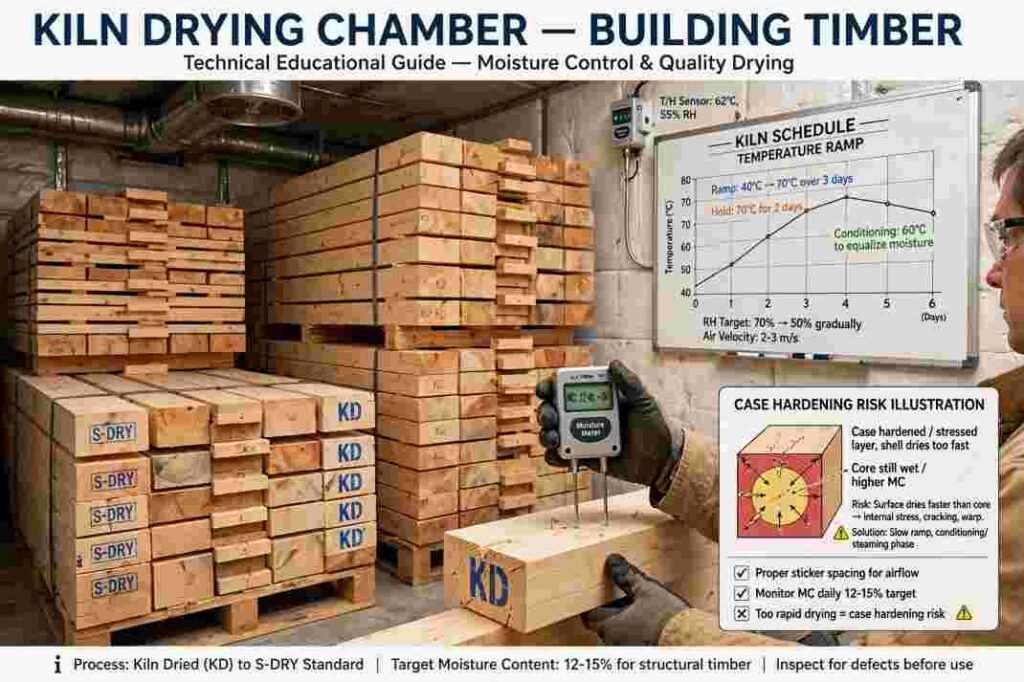
Green lumber from the saw contains free water in the cell cavities and bound water in the cell walls, and it will shrink as it dries. The mill either air dries the stock in a yard or kiln dries it in a controlled chamber, and the choice depends on species, thickness, and the intended market. Framing lumber is typically kiln dried to a target moisture content somewhere between 15 and 19 percent for dimension stock, with a stamp designation of S-DRY or KD indicating the drying condition. The American Wood Council maintains published design values and drying references that specifiers rely on when they need to verify what a given stamp actually means.
A kiln schedule that ramps temperature too quickly will case harden the lumber, leaving the shell dry and the core wet, which sets up internal stresses that release as soon as the board is cut at the job site. The board looks fine on the rack and then bows the moment a framer crosscuts it, and the framer blames the yard while the actual cause was a kiln operator chasing a production target. Checking moisture content with a pin meter before installation is inexpensive compared to the labor cost of replacing a floor system that shrank out of tolerance.
Air drying is slower and gentler but varies with ambient humidity, which makes it a poor fit for markets that need predictable stock. Some mills blend the two approaches, air drying to a preliminary target and finishing in the kiln. The question of how is building timber made rarely gets answered in a supplier conversation beyond the stamp, but the drying history is where most of the hidden quality lives.
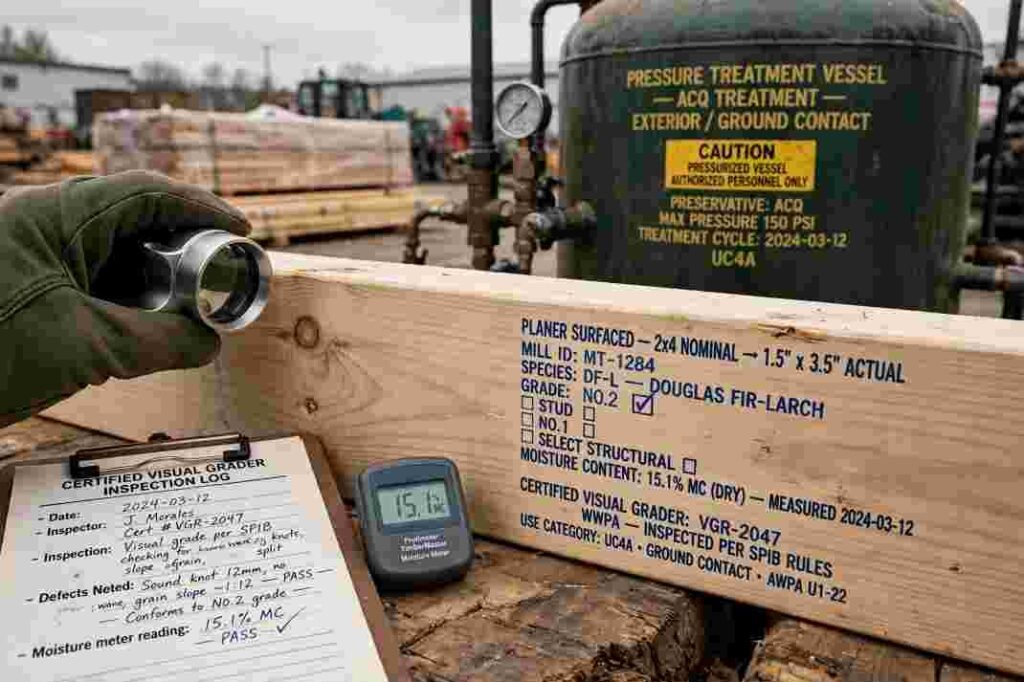
After drying, the rough stock moves through a planer that surfaces all four sides to a final dimension, which is why a nominal 2×4 actually measures 1.5 inches by 3.5 inches. That change in dimension was standardized decades ago so that rough and surfaced lumber could be specified clearly, and the National Institute of Standards and Technology documents the dimensional standards that underpin the trade. Grading happens after surfacing, either by a certified visual grader or by a machine that measures stiffness and density.
| Grade | Typical Use | Defect Tolerance
|
|---|---|---|
| Stud grade | Vertical wall framing | Allows more knots, restricts wane |
| No. 2 | General framing, plates, joists | Moderate knots and slope of grain |
| No. 1 | Higher stress framing | Tighter defect limits |
| Select Structural | Headers, beams, engineered applications | Most restrictive defect limits |
Physical grading is a visual inspection against a published rule book, and machine grading relies on a stress rating that assigns an allowable design value to each piece. Either way, the resulting stamp identifies the mill, the grade, the species group, and the moisture content condition, and that stamp is what a building inspector checks when the framing is on the wall. A framer who has ever had an inspection red tag a stack of unmarked lumber understands why the stamp is not decorative.
Lumber headed for exterior use, deck framing, sill plates, or any ground contact application passes through a pressure treatment cycle that forces preservative into the wood cells under vacuum and pressure. The treatment category, whether ground contact or above ground, dictates the retention level of the chemical and therefore how long the piece will survive in service. The American Wood Protection Association publishes the use category standards that treatment plants follow, and the end tag on each piece states the retention level and the use category it was rated for.
The treatment process itself is straightforward. The charge of lumber goes into a pressure vessel, a vacuum pulls air out of the cells, the vessel fills with preservative solution, pressure forces the solution in, and a final vacuum pulls excess liquid back out before the charge is drained and the stock is moved to a drip pad.
Cutting treated lumber at the job site exposes untreated interior wood, which is why field cuts on ground contact pieces require a field applied preservative, and why framing crews who skip that step end up with posts that rot from the cut in eight or nine years. The question of how is building timber made for exterior use has a second production cycle layered onto the first one.
In discussions exploring what is a green building, understanding how sustainable materials are processed is essential. Not all building timber leaves the mill as a solid sawn board. A significant share of the log stream is converted into veneers, strands, or chips and then reconstituted into engineered products, and each of those processes changes how the material behaves under load. Plywood peels a log against a knife to produce veneers that are glued in cross plies, while oriented strand board slices logs into strands that are glued and pressed into mats. Glulam laminates dimensioned boards into a deep beam, and laminated veneer lumber presses veneers into a structural member that outperforms solid sawn stock of similar dimension.
A framer who asks how is building timber made for a floor system may get an answer that involves a truss plant rather than a sawmill, because the joists and the web members are engineered products with published span tables. Those span tables allow longer clear spans with less material than solid sawn joists, playing a direct role in reducing construction waste while changing the design of the floor above. The mill that produced the veneer and the plant that pressed the I-joist may be in different states, and the supply chain for engineered timber is longer and more specialized than the chain for a bunk of studs.
Verifying a load of timber at the yard comes down to a few concrete checks. Look for the grade stamp and confirm it matches the specification, check the moisture content with a meter on a few pieces from different parts of the stack, and inspect for wane, excessive knots, and any sign of fungal growth or sticker stain. Sorting a bunk before it goes to the framing crew takes twenty minutes and saves the labor of pulling bad pieces off the wall later. A buyer who understands how is building timber made can read a stamp and predict how the board will behave, which is a far better position than trusting the yard’s word.
The supply chain from standing timber to framed wall has more decision points than most buyers realize, and each one is a production constraint rather than a marketing claim. Specifying the grade, verifying the moisture condition, and confirming the treatment category before the load leaves the yard gives the builder a defensible position when the framing inspection arrives, and it shifts the burden of proof back to the supplier where it belongs.
Builders in coastal and high humidity markets who insist on documented kiln drying and stamped grading are not being difficult, they are pricing the risk of what happens when a floor system shrinks out of tolerance nine months after the homeowner moves in. The next time a supplier quotes a load without a moisture certificate, ask for the kiln schedule and watch how the conversation changes.