 11
BuildBlock Building Systems manufactures insulated concrete forms, the hollow foam blocks that crews stack into wall shapes and fill with reinforcing steel and concrete. That single sentence answers most of what does BuildBlock building systems do, but the full answer runs deeper into how a small Oklahoma manufacturer turned a commodity product into a licensed production network. The company does not pour walls itself and it does not build houses. It sells the formwork, the engineering support, and the franchise-style manufacturing rights that let regional plants mold the same block under license.
Pacific Construction Builders readers who have priced residential wall assemblies already know the ICF category exists. What most owners miss is the manufacturing model behind the brand, because the supply chain determines lead times, freight cost, and whether a local distributor can service a job at all. Understanding what does BuildBlock building systems do means understanding where the product stops and the builder’s responsibility starts.
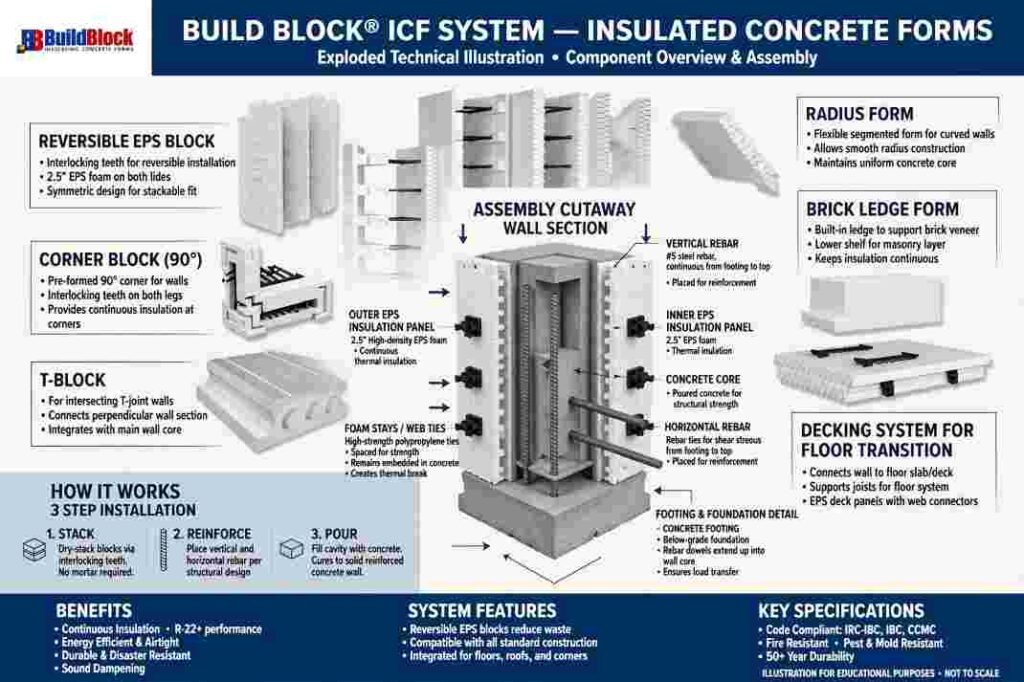
The company’s flagship product is the BuildBlock ICF, a reversible block molded from expanded polystyrene with interlocking teeth on the top and bottom edges. Crews dry stack the forms, place vertical and horizontal rebar, brace the walls, and pump concrete into the cavity in lifts. The foam stays in place permanently and becomes the insulation layer on both faces of the wall. BuildBlock also produces corner blocks, T-blocks, brick ledge forms, and radius forms that let a crew turn a curved wall without cutting and improvising on site.
The block line extends beyond the straight wall. BuildBlock sells a decking system for floor and roof transitions, and the company’s GlobalBlock line targets larger commercial cavities. The technical documentation on the manufacturer’s site lays out the full family of forms, including the product catalog published by BuildBlock, which is where a serious estimator should start before pricing a job.
None of this is exotic in the ICF world. Competitors like Nudura and Fox Blocks sell similar geometries. What separates BuildBlock operationally is how the company distributes manufacturing rather than shipping finished foam across the country from a single plant.
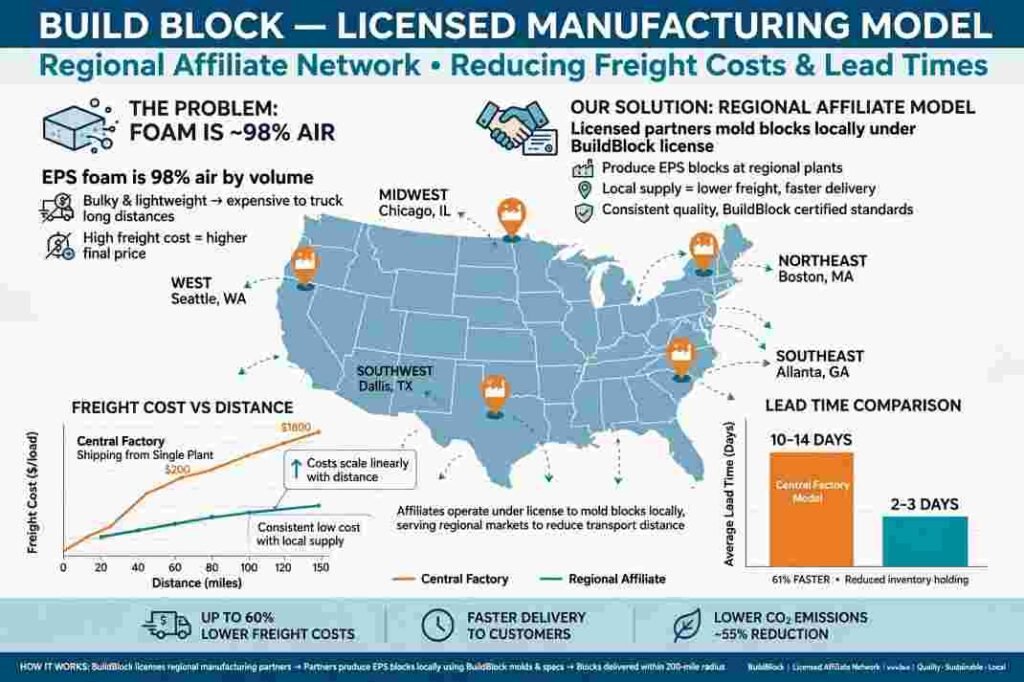
Foam is mostly air, and air is expensive to truck. A block that weighs a few pounds occupies a large volume, so freight cost per square foot of wall climbs fast once a plant is more than a few hundred miles from the jobsite. BuildBlock solved that problem by licensing regional manufacturers to mold the product locally under the company’s tooling and quality standards. The company calls these facilities manufacturing affiliates, and the arrangement lets a builder in the Pacific Northwest source block from a plant in the region instead of waiting on a shipment from the Midwest.
This matters for schedule. A licensed plant can produce block on a short cycle because the mold and the raw bead supply sit on the same site. A general contractor planning a basement pour in a wet climate can call a regional affiliate and confirm production dates rather than guessing at a national distributor’s inventory. The tradeoff is that quality control depends on the affiliate, so a buyer should verify that the plant is current on its license and that the block carries the required evaluation report.
The evaluation side is where the paperwork lives. ICF wall assemblies used in structural applications typically need a code evaluation service report, and the ICC Evaluation Service publishes the acceptance criteria that govern these products, which you can review through the ICC Evaluation Service directory. A local code official will ask for that report number, and the affiliate should provide it without a fight.
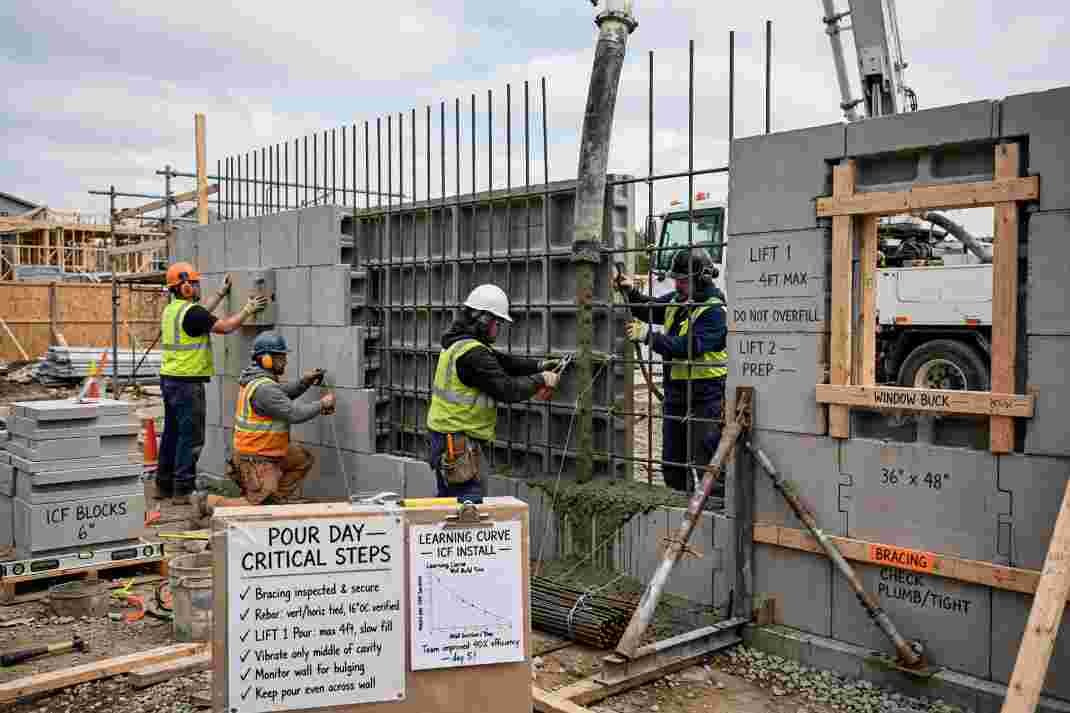
The company’s direct customers are not homeowners. They are builders, concrete subcontractors, and distributors who buy forms by the truckload for projects ranging from residential envelopes to heavy-duty industrial building design. What does BuildBlock building systems do for the person writing the check on a house? It supplies a wall system that a trained crew can install, and it backs that system with technical support, training courses, and takeoff assistance. The company runs installer training that covers bracing, pour sequencing, and window bucking, which is the part of ICF work that separates a clean wall from a blowout.
BuildBlock also provides engineering support for the reinforcing design. An ICF wall is not a generic concrete wall, because the foam forms change how the wall behaves under lateral load and how the concrete consolidates during placement. Builders who treat an ICF wall like a standard formed wall usually find out during the pour. The manufacturer’s engineering team reviews wall heights, soil pressures, and opening sizes, and returns a reinforcement schedule the crew can follow.
For the homeowner, the practical output is a wall assembly with a continuous insulation layer, an air barrier, and a structural concrete core in one operation. The energy performance claims get repeated a lot in marketing material, so a cautious owner should look at independent data rather than a brochure. The U.S. Department of Energy’s building technologies office maintains a technical reference on insulated concrete form performance through the DOE, and that material is a more reliable starting point for thermal and moisture questions than a dealer’s presentation.
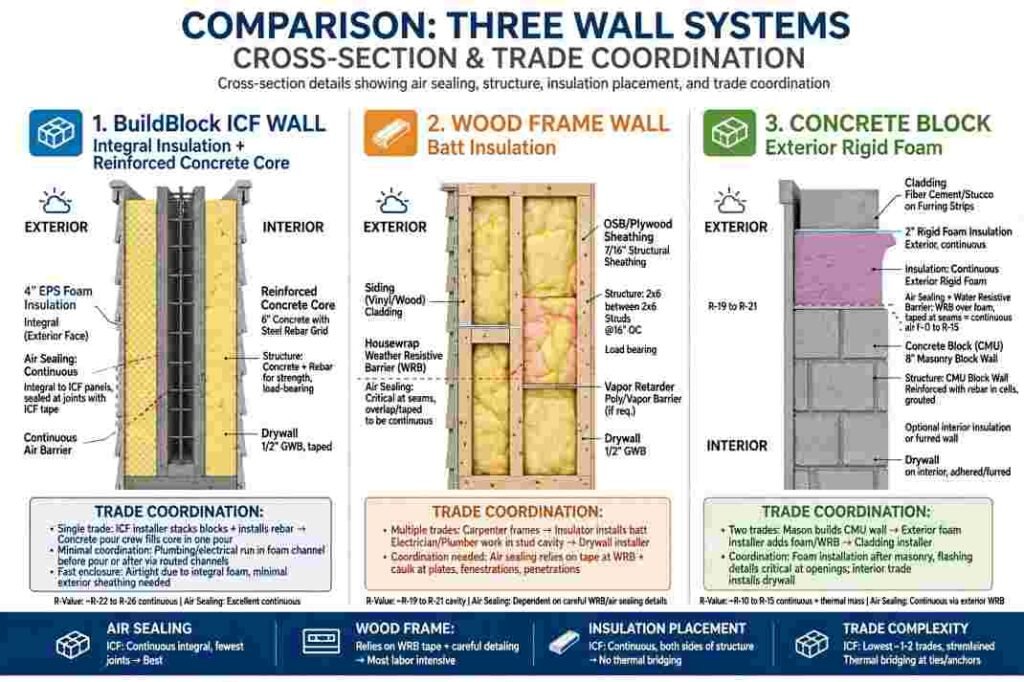
An owner comparing wall assemblies needs a straight table, not a sales pitch. The comparison below reflects how an ICF wall from BuildBlock stacks up against the two wall systems most often priced against it on residential jobs.
| Attribute | BuildBlock ICF Wall | Wood Frame with Batt Insulation | Concrete Block with Exterior Rigid Foam
|
|---|---|---|---|
| Structural core | Reinforced concrete in foam form | Dimensional lumber | Unreinforced or reinforced masonry |
| Insulation placement | Integral to form, both faces | Cavity only | Applied to exterior face |
| Air sealing | Concrete core plus foam faces | Relies on sheathing and tape | Relies on coating or membrane |
| Typical crew learning curve | Steep for first pour, then fast | Low | Moderate |
| Freight sensitivity | High, favors local affiliate | Low | Moderate |
| Trade coordination | Concrete, rebar, bracing, and form trades | Framing and insulation trades | Masonry and waterproofing trades |
The table hides the one variable that sinks most ICF budgets: crew experience. A framing crew can produce a straight wood wall on its first day. An ICF crew cannot, and the first pour on a job is where bracing errors and missed rebar show up. Contractors who ask what does BuildBlock building systems do usually want to know whether the manufacturer will train their people, and the answer is yes, but the training is not a substitute for a foreman who has poured walls before.
An estimator pricing an ICF wall should treat the forms as a long-lead item and treat freight as a line item with real weight. BuildBlock’s affiliate network changes the math depending on region. In a state with an active manufacturing affiliate, block may arrive within a couple of weeks. In a region with no affiliate, the block has to travel, and the freight quote can swing the whole assembly cost past a wood frame alternative.
The ordering sequence for a typical residential job looks like this:
That list is short, but every item on it has burned a contractor at some point. The bracing line is the most common miss, because a crew that budgets block and concrete but forgets the rental cost of braces will watch margin evaporate on the first wall.
No single wall system wins on every job. ICF makes the most sense on projects where the owner wants a single assembly that handles structure, insulation, and air sealing at once, and where the site can absorb the concrete logistics of a pump truck and a steady pour schedule. It makes less sense on small additions where the form count is low and the mobilization cost dominates, or on projects where the local labor pool has never touched an ICF form and the schedule has no room for a learning curve.
BuildBlock’s own positioning leans toward residential basements, safe rooms, and storm-resistant construction, which tracks with the product’s home market in tornado-prone states, while naturally reducing construction waste through interlocking EPS forms that eliminate disposable wood formwork. A builder in the Pacific Northwest will care more about moisture detailing at the sill and the transition to the rim, while a builder in Oklahoma will care more about wind uplift and debris impact. The same form works for both, but the detailing conversations differ, and the manufacturer’s technical staff is the resource that answers them.
The differentiator is the combination of local manufacturing rights and a technical support structure that scales with the affiliate. A builder working with a licensed plant gets forms molded to the current specification, access to the manufacturer’s engineering review, and a training path for new crew members. What does BuildBlock building systems do that a reseller cannot? It controls the tooling and the specification, so the block coming out of an affiliate in one state matches the block coming out of an affiliate three states away. That consistency is what lets a national builder standardize a wall detail across regions.
The company also maintains a dealer and distributor structure that handles small orders, which matters for a remodeler who needs forty blocks rather than a full truck. A homeowner acting as an owner-builder will find that path easier than trying to buy direct from a plant, because the plant sells to distributors and not to individuals with a pickup truck.
The answer to what does BuildBlock building systems do fits in a procurement file: it manufactures and licenses insulated concrete forms, it provides engineering and training support for the crews that install them, and it distributes through regional plants so that foam does not travel farther than it has to. A builder evaluating the system should start with the local affiliate, confirm the evaluation report, and get the reinforcement schedule in hand before the schedule is locked. The formwork is the easy part. The pour day is where the project succeeds or fails, and that day belongs to the crew, not the manufacturer.