 11
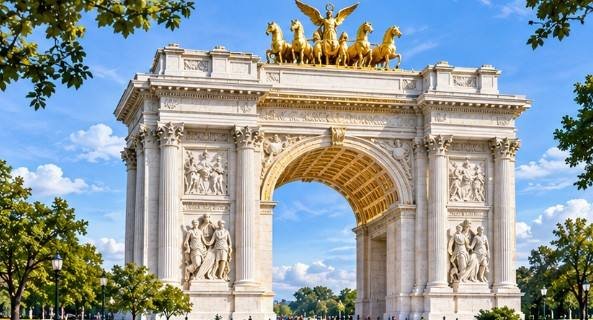
Is Trump building an arch? As of this writing, a triumphal arch has been proposed for a federal site near the Potomac in Washington, DC, and the concept has moved through design renderings and early political announcements without a signed construction contract or an issued building permit.
The question keeps surfacing because the proposal sits at the intersection of three stubborn realities: federal land control, the National Capital Planning Commission review process, and the simple fact that a monument of this scale requires years of engineering before a single footing is poured. Anyone who builds for a living recognizes the gap between a rendering and a ribbon cutting, and that gap is where this story actually lives.
The short answer to whether Trump is building an arch is that no confirmed groundbreaking exists, the funding mechanism remains contested, and the site selection is still being debated in public comment periods.
The longer answer requires walking through what a triumphal arch is in structural terms, who has jurisdiction over the land, what the approval chain looks like, and what a contractor would actually face if the project advanced. That is the frame this article uses, because the construction industry has seen plenty of monument proposals die in the entitlement phase and a handful survive it.
A triumphal arch is a freestanding masonry or clad monument, typically with one central passage and often flanked by smaller side passages, crowned by an attic block that carries inscriptions or sculpture.
The Roman precedent, from the Arch of Titus to the Arch of Constantine, used cut stone and concrete with massive abutments to carry the load around the opening. Modern versions, including the Arc de Triomphe in Paris and the Wellington Arch in London, follow the same load path: the arch ring transfers compression into piers, the piers transfer it into spread footings, and the attic sits as dead load on top.
Is Trump building an arch of that classical type? The public renderings suggest a neoclassical design with a large central opening, decorative relief panels, and a gilded sculptural element, which places it in the same family as the Paris and London precedents.
That matters for construction because every element in the rendering has a cost and a schedule consequence. Cut stone cladding on a curved surface is slow work. Gilding requires scaffolding and weather windows. Sculptural relief panels require fabrication shops with long lead times. None of that is exotic, but all of it is expensive, and the cost curve for a monument of this type scales faster than most public projects because the tolerances are tighter.
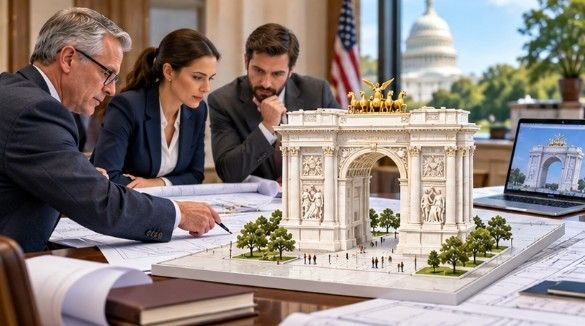
The site conditions near the Tidal Basin and the Potomac floodplain matter enormously. Much of the ground in that part of Washington sits on fill and alluvium over older river deposits, and the water table is shallow. A structure of this mass would almost certainly require deep foundations, either driven piles or drilled shafts, to reach competent bearing strata.
The U.S. Geological Survey maintains regional geology and groundwater data that any design team would pull for a site of this type, and the findings typically push foundation costs well above what a naive estimate assumes.
That is the part of the arch conversation the political coverage skips. A triumphal arch is not a statue on a plinth. It is a building with a hole in the middle, and the hole is the hardest part.
The arch ring has to be formed, the centering has to stay in place until the mortar or the concrete reaches strength, and the temporary works alone can run into the millions on a project this size. Any contractor who has built a large span knows the centering and falsework are not a footnote in the budget.
Federal land in Washington, DC is not like private land in Fairfax County. The National Capital Planning Commission reviews federal projects in the capital region, and its review is not a courtesy.
The Commission has statutory authority over federal development in the National Capital Region, and projects that touch the monumental core routinely go through multiple submissions, design revisions, and public hearings before they receive approval. The National Park Service controls much of the land in question, and NPS approval is a separate gate from NCPC review.
Add to that the Advisory Council on Historic Preservation and the Section 106 review process under the National Historic Preservation Act. Any project near the National Mall, Rock Creek Park, or the Tidal Basin triggers consultation because those areas are eligible for or listed on the National Register.
Section 106 is not a veto, but it is a long, documented, comment-driven process, and it can add years. The question of is Trump building an arch therefore cannot be answered without knowing where the project sits in that chain, and the public record shows it is still early.
| Review Gate | Authority | Typical Duration | What It Can Do
|
|---|---|---|---|
| Site selection and land use | National Park Service | 6 to 18 months | Approve, deny, or condition the use of federal land |
| Design review | National Capital Planning Commission | 3 to 12 months, multiple cycles | Require redesign or reject the submission |
| Historic preservation | Advisory Council on Historic Preservation | 6 to 24 months | Mandate mitigation or alternatives analysis |
| Environmental review | Lead federal agency under NEPA | 9 to 36 months | Require EIS, which restarts the clock |
| Building permit and code | DC Department of Buildings | 3 to 9 months | Enforce code compliance on the final design |
Those durations are not guesses pulled from thin air. They reflect the observed range for comparable federal projects in the capital region, and anyone who has worked on public work in the District will recognize the pattern. The DC Department of Buildings publishes its own permitting timelines and fee schedules, and those are the least of the hurdles on a project of this profile.
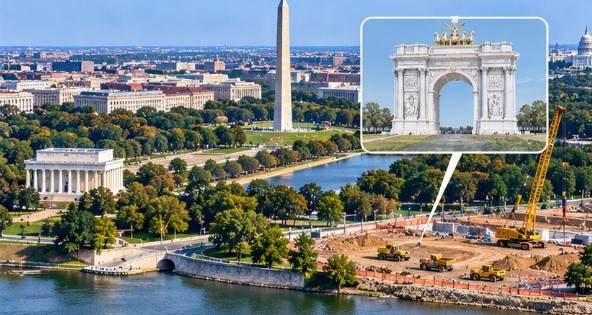
The reason is Trump building an arch keeps resurfacing as a search query is that the funding story has never been clean. Federal appropriations for a commemorative work normally run through a specific authorization, and private fundraising for monuments on federal land has its own statutory framework.
The Commemorative Works Act sets out the process for establishing memorials in the District, including a prohibition on new memorials on certain reserved areas of the Mall, and any arch proposal would have to fit within that statute or seek an exemption from Congress.
That is where the practical construction question intersects with the political one. A project without an authorization and without a confirmed funding source cannot solicit serious bids.
Similar funding and approval questions have emerged around why Trump is building a White House ballroom, another high-profile federal construction project involving private donations, historic preservation, and government oversight.
General contractors do not mobilize for a monument on a handshake, and bonding companies do not issue performance bonds against a rendering. If the project reaches the point where a guaranteed maximum price contract is being negotiated, the industry will know, because the bid list will leak within a week.
A triumphal arch of the scale shown in the renderings would land in the range of a mid-sized commercial building, and possibly higher given the site conditions and the cladding. The budget would include design and engineering fees, deep foundation work, structural concrete or stone for the arch ring, cladding and relief sculpture, gilding and bronze elements, site work and landscaping, security infrastructure, lighting, and a construction management contingency that runs 10 to 15 percent on public work.
Monument projects also carry a separate conservation and maintenance endowment, because stone and bronze need cyclical cleaning and repatination.
None of those line items are optional. The U.S. General Services Administration publishes cost guidance and project delivery standards for federal construction that give a sense of how these budgets are assembled, and the pattern is consistent: the visible structure is roughly half the cost, and the invisible work of foundations, temporary works, security, and long-term maintenance is the other half.
Is Trump building an arch without that budget being public? The record suggests the detailed budget has not been released, which is one reason the project remains in the speculative column.
The locations floated in public discussion each carry different engineering and regulatory profiles. A site near the Tidal Basin brings floodplain concerns and shallow groundwater. A site along the Potomac waterfront brings jurisdiction questions between federal and District agencies.
Also a site near existing memorials brings Section 106 consultation with a long list of consulting parties. Each option changes the foundation design, the haul route for materials, the crane placement, and the construction schedule.
Construction logistics in the monumental core are their own discipline. Crane picks near the Mall require coordination with NPS, the National Park Service police, and often the Secret Service if a protected site is nearby. Concrete trucks cannot stage on the Mall.
Deliveries of cut stone have to be sequenced against events, protests, and the tourist calendar. A contractor bidding this project would build a logistics plan that looks more like an event management plan than a typical building schedule, and that plan would add cost that never appears in the renderings.
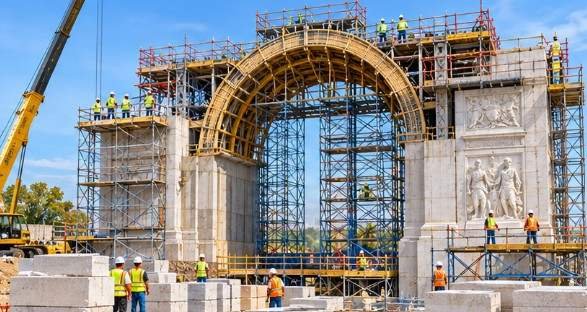
The Washington Monument took decades to complete, with a pause in construction that left the shaft at different heights for over twenty years before work resumed. The Lincoln Memorial took roughly eight years from authorization to dedication.
The World War II Memorial took years of site debate before construction began. The pattern is consistent: the political and regulatory phase consumes more time than the physical build, often by a wide margin.
Anyone asking is Trump building an arch should read those precedents carefully. The arch proposal is currently in the phase where monuments spend most of their lives, which is the argument phase.
Construction is the shortest part of the timeline on almost every major monument in the capital, and it is the part that has not started here. The renderings are a design concept, not a construction document. The public statements are advocacy, not a notice to proceed.
| Monument | Authorization to Groundbreaking | Groundbreaking to Dedication
|
|---|---|---|
| Washington Monument | Roughly 16 years | Roughly 37 years with a long pause |
| Lincoln Memorial | Roughly 11 years | Roughly 8 years |
| World War II Memorial | Roughly 6 years after final site approval | Roughly 3 years |
| Martin Luther King Jr. Memorial | Roughly 12 years | Roughly 5 years |
The lesson is not that monuments are slow by accident. They are slow because federal land, historic preservation review, and public comment are designed to be slow, and because the funding has to be assembled before a general contractor will sign a contract. The arch is subject to the same machinery.
Firms that pursue monument and civic work track a specific set of signals. The first is a congressional authorization with a defined scope. The second is an appropriation or a documented private fundraising commitment held in an account that can pay progress invoices.
The third is a construction manager selection, which is usually announced publicly because it requires a procurement. The fourth is a notice to proceed. Until those four signals line up, a project is a concept, and the bid community treats it accordingly.
Is Trump building an arch at the point where any of those signals have fired? Not according to the public record. That could change quickly if Congress acts or if a private donor steps forward with a fully funded commitment. The industry would respond within weeks if it did.
But the gap between a rendering and a notice to proceed is where most monument ideas live and die. The arch is sitting in that gap right now.
Each of those items produces a public document. Each document is a breadcrumb. When several appear in the same quarter, the project is real. When none appear for a year, the project is a press release. The arch has produced renderings and statements, and the gray literature of federal procurement is the thing to watch next.
The arch proposal is a live political story wrapped around a stalled construction story. The design exists as a concept. The site has been discussed in public. And the review and funding gates that any federal monument must clear have not been satisfied.
The engineering is tractable, the regulatory path is long, and the budget is the open question. Anyone who asks is Trump building an arch deserves that specific answer. Rather than a yes or a no. Because the honest answer is that the project is in the phase where the outcome is decided by paperwork rather than by cranes.
Watch the Federal Register, watch the NCPC hearing calendar, and watch for a geotechnical contract award. Those three sources will tell you the real status of is Trump building an arch. Long before any official announcement. They are the same sources a contractor would use to decide. Whether to spend money chasing the job.
The project will either produce those documents in the next cycle or it will quietly join the long list of monuments that never got past the rendering.