 11
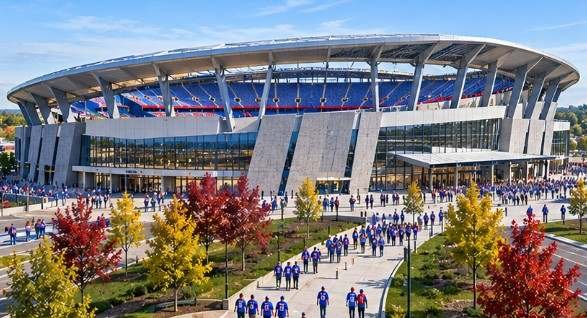
The short answer to are the Buffalo Bills building a new stadium is yes, and the work is already well past the drawing stage. The Bills are constructing a new open-air facility in Orchard Park, directly adjacent to the existing Highmark Stadium, with a targeted opening for the 2026 NFL season.
That single sentence hides a decade of negotiation, a public financing fight, and one of the more interesting site logistics problems in recent American sports construction. What follows is a working description of the project as a build, not as a headline.
People keep asking are the Buffalo Bills building a new stadium because the project straddles so many jurisdictions at once: a county, a state, a private ownership group, and a league that prefers to keep its capital commitments quiet. The construction professional’s version of that question is narrower.
Who is building it, what is the delivery method, what does the site actually look like, and what does the schedule mean for anyone who touches a project of this size. That is the ground this article covers.
The decision was replacement, not renovation. Early in the process the club and its consultants studied a rebuild of the existing facility, and the numbers on a full tear-down and replace came back more favorable once the site constraints were priced in.
The old stadium opened in 1973 and has been patched repeatedly, which is the normal life cycle of a concrete bowl built in that era. Renovation scenarios kept running into the same wall: too much deferred structural work, too few premium seating opportunities, and a footprint that never anticipated modern broadcast and concession infrastructure.
So the answer to are the Buffalo Bills building a new stadium carries a second implication. The project is new construction on a greenfield-adjacent parcel, which means the full sequence applies: mass grading, foundations, structural steel, enclosure, and interior fit-out, all running against a fixed league calendar. There is no phased occupancy here.
A stadium either hosts a game in September of its opening year or it does not, and the schedule has one immovable date.
| Item | Detail
|
|---|---|
| Location | Orchard Park, New York, on the parcel immediately north of the current stadium |
| Owner | Erie County, with the Buffalo Bills as tenant and operator under a long-term lease |
| Delivery model | Construction management at risk, executed by a joint venture of national and regional contractors |
| Roof | Open air, no dome, no retractable system |
| Seating capacity | Roughly 60,000, with a smaller bowl and heavier premium ratio than the old building |
| Target opening | 2026 NFL season |
| Reported project cost | Approximately $2.2 billion, revised upward from earlier estimates |
The capacity figure is where most casual observers get confused. The new building seats fewer people than the old one, and that is not a cost-cutting move. Modern stadium economics push toward a smaller bowl with more club space, more field-level product, and a larger share of revenue tied to premium inventory. Fewer seats, higher yield per seat. Any contractor who has priced a hospitality build understands the trade.
Public money is in this project, and the amount is documented. Erie County and New York State committed a combined public contribution that was negotiated with the team and codified in a formal agreement, and the county’s own materials lay out the terms of the lease and community benefit obligations that attach to it.
The Erie County stadium agreement page is the most reliable public reference for the structure of that deal, including the non-relocation terms and the county’s ownership position on the facility.
On the team side, the NFL’s G4 stadium loan program supplied a financing tranche, and the league’s own documentation explains how that program works and what it funds. That matters to builders for a practical reason: projects with public funding and league lending carry layers of reporting, minority participation requirements, and change-order review that a purely private developer would never accept.
If you are a subcontractor asking are the Buffalo Bills building a new stadium with public oversight, the answer is yes, and the paperwork reflects it.
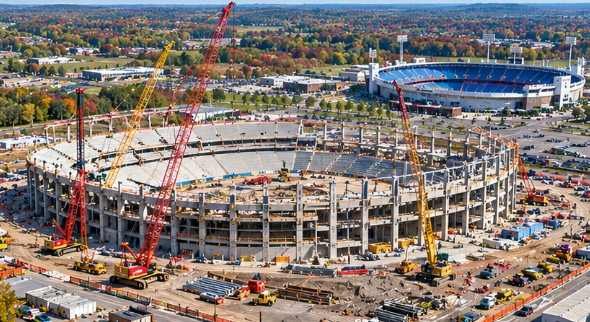
Building a stadium next to an operating stadium is the defining constraint on this job. The new footprint sits on the north side of the existing facility, which means every home game weekend turns the shared site into a crowd management problem for the contractor as much as for the sheriff’s office.
Deliveries get curtailed on game days, laydown areas get replanned, and the tower crane positions are set so that nothing swings over a public route during a Sunday event.
Winter is the other hard variable. Western New York produces lake-effect snow bands that can drop a foot on a site in an afternoon, which pushes concrete pours and steel erection into a compressed calendar.
Contractors on this project worked through multiple heating seasons, and any owner contemplating a northern stadium build should assume winter weather sequences will slip unless the schedule carries explicit float for them. That is not pessimism. It is the historical record of the region.
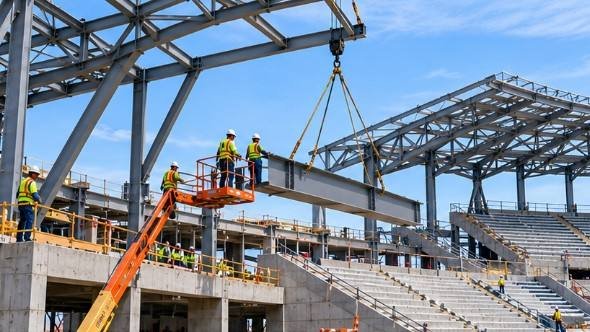
The structural scheme follows the standard contemporary stadium pattern: a cast-in-place concrete lower bowl and concourse structure, steel framing for the upper deck and roof canopy, and a long-span canopy system cantilevered over the seating.
The canopy is not decorative. It carries lighting, sound, and snow load considerations, and it is one of the heaviest coordination items between the structural and MEP trades.
Enclosure is where open-air buildings get interesting. There is no dome membrane to install, so the envelope is a combination of precast and masonry cladding, glazed concourse walls, and a fully engineered roofing assembly on the occupied spaces beneath the seating bowl.
The structural engineering resources published by NIST are a useful reference for anyone wanting to understand how modern large-assembly structures are analyzed for wind and seismic performance, and the same analysis framework applies to a building of this scale.
The construction manager is a joint venture that pairs a national sports builder with a Buffalo-based firm, which is standard practice on projects funded partly with public money.
The joint venture structure satisfies local participation expectations, keeps regional subcontractor relationships in the room, and gives the owner the stadium-specific experience that a local firm alone would not carry. If you are tracking who is actually pouring concrete and setting steel, are the Buffalo Bills building a new stadium is really a question about which regional trades are on the bid list, and the answer is most of them.
Construction management at risk, rather than design-bid-build, was chosen for a predictable reason. On a fast-track sports project the owner needs a builder at the table during design so that means and methods get priced before the drawings are final.
CM at risk also puts the contractor on the hook for a guaranteed maximum price, which transfers schedule and cost overrun risk away from the county and onto the builder. That transfer is never free. It shows up in contingency and in the fee.
Are the Buffalo Bills building a new stadium on time is a different question from whether they are building one at all, and the honest answer is that the schedule is tight but the major structural work is substantially complete. Steel erection and the seating bowl were the long-lead items, and once those are finished the remaining risk sits in the interior trades, the broadcast infrastructure, and the commissioning sequence.
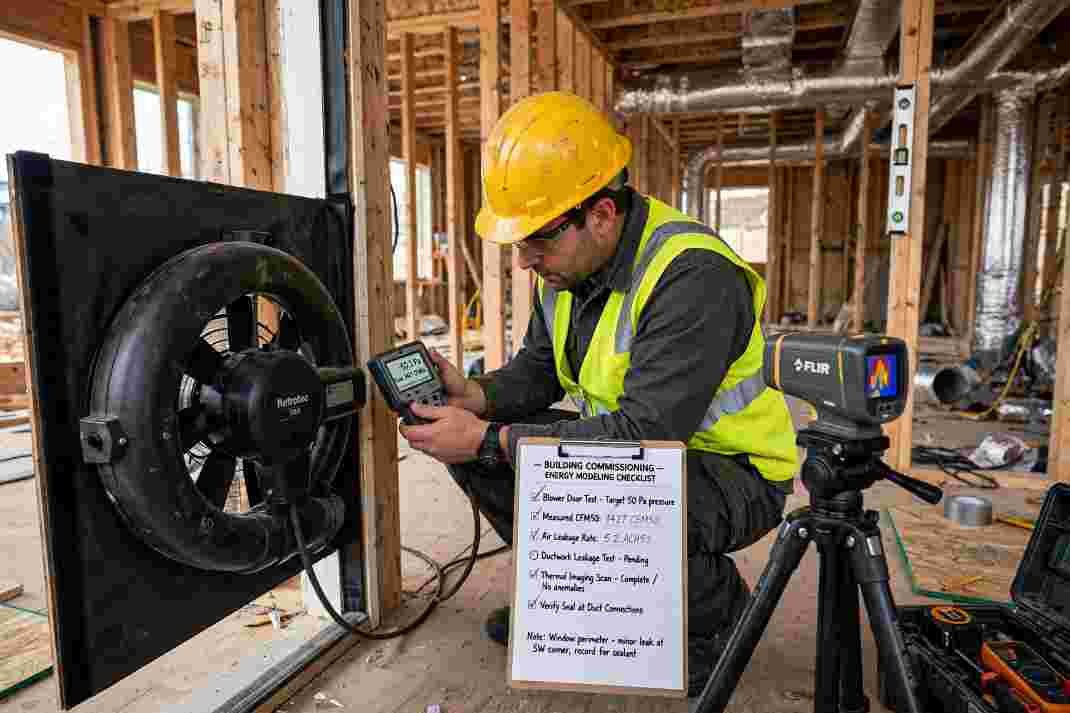
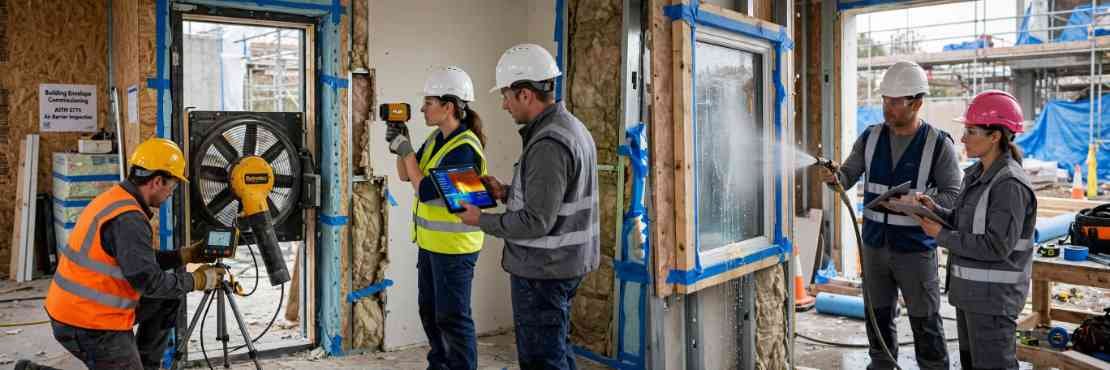
Commissioning is where stadiums usually stumble, because the systems that run a modern venue are more complex than the structure that holds it up.
The team has published its own project information, and the Buffalo Bills new stadium page is the primary source for current milestones, renderings, and the club’s stated opening timeline. Owners and builders tracking comparable projects should watch how this one handles the final twelve months, because that window is where every stadium job either lands cleanly or generates a year of press about delays.
At roughly $2.2 billion for about 60,000 seats, the new Bills facility lands somewhere north of $35,000 per seat. That number is high by the standards of a decade ago and unremarkable by the standards of the current NFL construction cycle, where stadium costs have climbed steadily as premium inventory and broadcast technology have expanded.
Comparing across projects is useful for owners who want a benchmark, though it requires care, because cost per seat varies wildly with roof type, site conditions, and how much surrounding development is bundled into the figure.
| Cost Driver | Effect on the Buffalo Project
|
|---|---|
| Open air design | Reduces cost relative to a domed or retractable roof facility |
| Adjacent operating stadium | Increases logistics and site management cost |
| Northern climate | Adds winter protection and schedule float costs |
| Public funding and oversight | Adds compliance, reporting, and participation requirements |
| Premium seating ratio | Raises interior fit-out cost per seat |
The stadium itself is only part of the construction story. Road improvements, utility upgrades, and parking reconfiguration around the Orchard Park site represent a parallel public works program that often gets less attention than the building.
For contractors, those packages are frequently more accessible than the main stadium trades, and they run on a similar schedule because the roads need to be ready before the first game.
There is also a demolition phase on the horizon. Once the new facility opens, the old Highmark Stadium comes down, and that work carries its own environmental and material handling requirements.
The county’s agreement materials address the disposition of the existing site, and anyone tracking are the Buffalo Bills building a new stadium should include the old building’s removal in the total project picture. A stadium replacement is a two-building transaction, not one.
Three lessons transfer to any owner running a large capital project. First, the immovable date drives every other decision, and a fixed opening event forces the schedule logic to run backward from occupancy rather than forward from design.
Second, public funding buys oversight, and owners who accept public money should price the compliance burden into the budget from day one rather than discovering it during construction.
Third, the site conditions around a project often cost more than the building itself, and the contractor who prices the logistics realistically is worth more than the one who bids low and finds the problems later.
For anyone tracking the construction side of the NFL’s current building cycle, the Buffalo project is a useful reference case because it combines almost every complicating factor at once: a northern climate, a public owner, a league lender, an active adjacent facility, and a single inflexible opening date.
Most owners will never build a stadium, but the sequencing logic and the risk transfer mechanics are the same on a $20 million commercial build as on a $2 billion one.
Are the Buffalo Bills building a new stadium has moved from speculation to a commissioning question, and the remaining risk sits in the systems and the finishing trades rather than the structure. The owner’s real test arrives in the months before opening, when the building must demonstrate that it can manage a full crowd, a broadcast production, and a winter storm at the same time.
Construction teams call that the turnover window, and it is where a project either proves its worth or exposes every shortcut taken during the previous three years. Watch how the joint venture handles commissioning, because that phase tells you more about the quality of the build than any rendering ever will.