 11
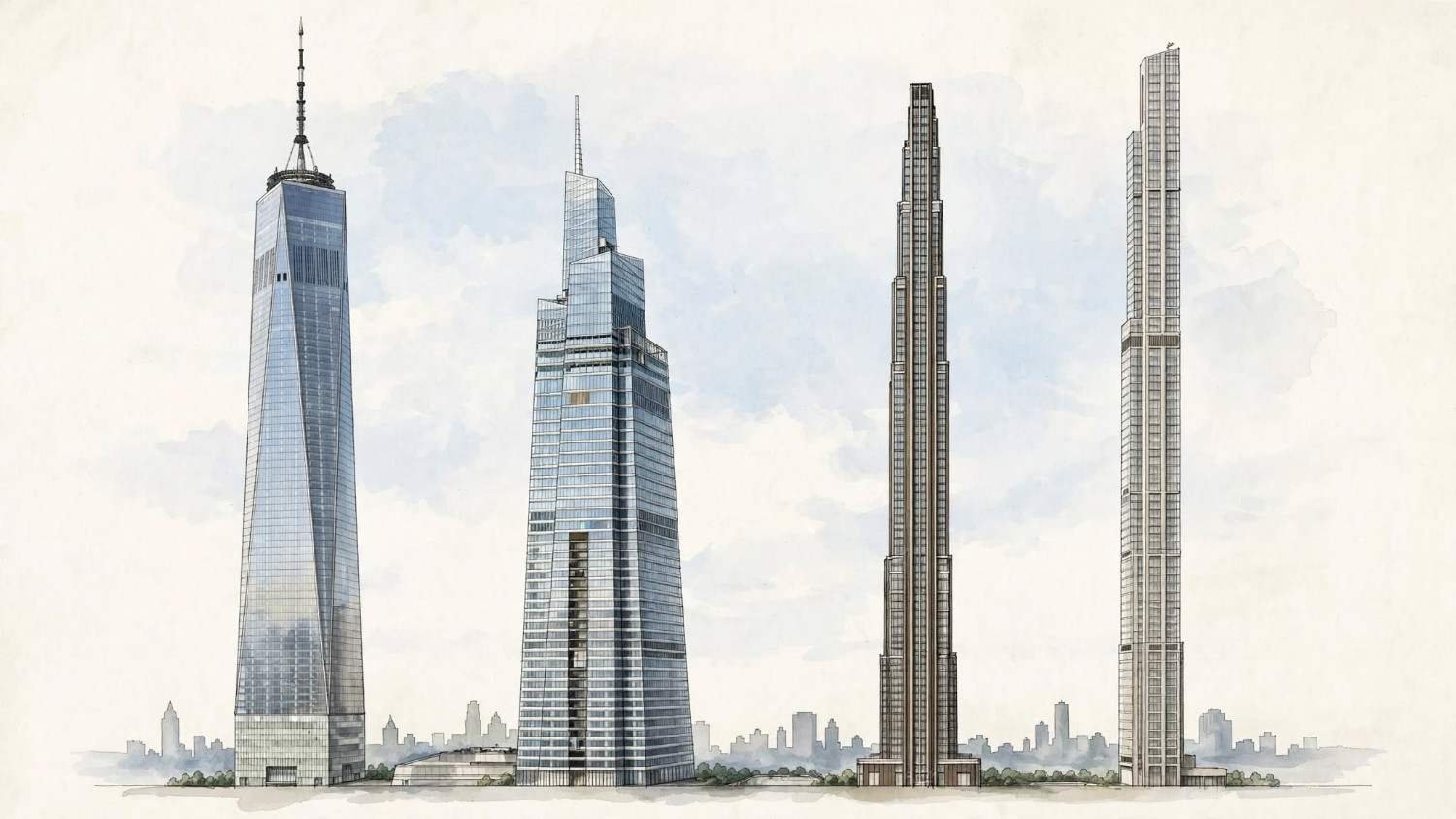
The tallest building in New York City is One World Trade Center, and the number that matters is 1,776 feet to the top of its spire. That figure is not trivia. It is the product of a very deliberate decision by the Port Authority and the design team at Skidmore, Owings & Merrill to hit a specific symbolic height in a city where the skyline is measured and litigated in equal parts. If you work in construction in this market, knowing what is the tallest building in New York City is is the entry point to a longer conversation about zoning, wind engineering, curtain wall logistics, and the fact that a building’s official rank depends entirely on which measurement you are reading.
Most searches for what is the tallest building in New York City assume there is a single clean answer. There is, but the moment you dig into the building trades the answer fragments into three vertical dimensions that never agree with each other: architectural height, roof height, and occupied floor height. The Council on Tall Buildings and Urban Habitat maintains the rules that govern those distinctions, and those rules decide who gets to claim the crown.
One World Trade Center rises 1,776 feet to its architectural top, a height chosen to reference the year of American independence. The roof of the parapet sits at 1,368 feet, and the observation deck occupies the upper floors below the spire. The building broke ground in 2006 and opened in 2014, and it has held the title of tallest building in New York City since the moment the spire was set in 2013.
The governing body for these rankings is the Council on Tall Buildings and Urban Habitat, which classifies the status of tall buildings worldwide and publishes the criteria that determine which structural element counts as the top. Under their framework, the architectural top of a building includes spires but excludes antennae, flagpoles, signage, and other functional or technical equipment. That single rule explains why the ranking of what is the tallest building in New York City has survived a decade of disputes from competitors who count differently.
There is a persistent argument that the spire on One World Trade Center is really an antenna, and therefore should be excluded. The CTBUH reviewed that objection and retained the spire as an architectural element because it is clad, integral to the design composition, and not a piece of removable broadcast equipment. The trade press covered the debate exhaustively at the time, and the outcome is now treated as settled within the industry.

Central Park Tower took the title of tallest residential building in the world by roof height when it topped out in 2019, and it reaches 1,550 feet to its architectural top. Its roof sits at 1,484 feet, which is higher than the roof of One World Trade Center. That detail trips up readers constantly. Anyone asking what is the tallest building in New York City by roof height gets a different answer than someone asking by architectural height, and Central Park Tower is why.
111 West 57th Street, marketed as Steinway Tower, reaches 1,428 feet and holds the distinction of the most slender skyscraper in the world, with an aspect ratio of roughly 24 to 1. The engineering required to hold that shape in a wind storm involved a tuned mass damper and a substantial structural core. The building is a demonstration of how much of Manhattan’s vertical growth now happens on extremely tight lots.
One Vanderbilt, completed in 2020 and connected directly to Grand Central Terminal, reaches 1,401 feet. The Brooklyn Tower, the first supertall in the borough, reaches 1,066 feet. The original World Trade Center’s North Tower reached 1,368 feet to the roof, matching the current roof height of its replacement, and held the title until 1973.
The following table lays out the top claimants by the metrics that matter in construction and real estate documentation. Note how frequently the ranking order changes depending on which column you read.
| Building | Architectural Height | Roof Height | Completed
|
|---|---|---|---|
| One World Trade Center | 1,776 ft | 1,368 ft | 2014 |
| Central Park Tower | 1,550 ft | 1,484 ft | 2020 |
| 111 West 57th Street | 1,428 ft | 1,428 ft | 2021 |
| One Vanderbilt | 1,401 ft | 1,401 ft | 2020 |
| 432 Park Avenue | 1,396 ft | 1,396 ft | 2015 |
| Empire State Building | 1,250 ft | 1,250 ft | 1931 |
| Brooklyn Tower | 1,066 ft | 1,066 ft | 2022 |
The Empire State Building illustrates the longevity problem in this ranking. It held the title of tallest building in the world for nearly four decades and remains the tallest building in New York City by the standards of anyone measuring to the roof of the occupied structure plus its antennae, though that position has been eclipsed on every official metric. Its floor plates, elevator zoning, and facade restoration cycle remain a reference case in commercial renovation work.
The Port Authority’s decision to fix the height of One World Trade Center at 1,776 feet came with construction tradeoffs. To reach that figure the tower needed a spire weighing hundreds of tons, installed in sections by a specialty rigging crew working at extreme altitude. The spire is a tuned structure, designed to resist wind loading and thermal movement, which is part of why engineers pushed back on calls to treat it as decorative equipment.
Zoning and air rights set the outer envelope for every one of these buildings. The Manhattan skyline exists because of the 1916 Zoning Resolution and the 1961 revision that followed, both documented in the New York City Department of City Planning archives. Those rules created the setbacks and tower-on-base forms that define the city’s supertalls. Air rights transfers from neighboring properties and from landmarks like Grand Central allowed One Vanderbilt and Central Park Tower to reach heights their own lots could not have supported.
Wind loading governs the structural design more than gravity does at these altitudes. The National Institute of Standards and Technology has published substantial research on tall building performance and wind effects, and the findings inform the tuned dampers, sloped facades, and interrupted corner details visible on nearly every supertall in Manhattan. A building that is 1,400 feet tall in this wind climate is a different structural problem than the same building in a calmer city.
Four measurement categories are in common use, and each one produces a different ranking. Architectural height counts to the top of the structural or clad form. Roof height counts to the top of the parapet or structural roof. Occupied floor height counts to the top of the highest occupiable floor, which excludes mechanical penthouses and observation decks. Tip height counts everything, including antennae.
The Empire State Building is a good example of how wide those categories can diverge, since its antenna adds more than 200 feet to its tip height that no official architectural measurement includes. Anyone asking what is the tallest building in New York City by tip height gets a technically correct but practically useless answer.
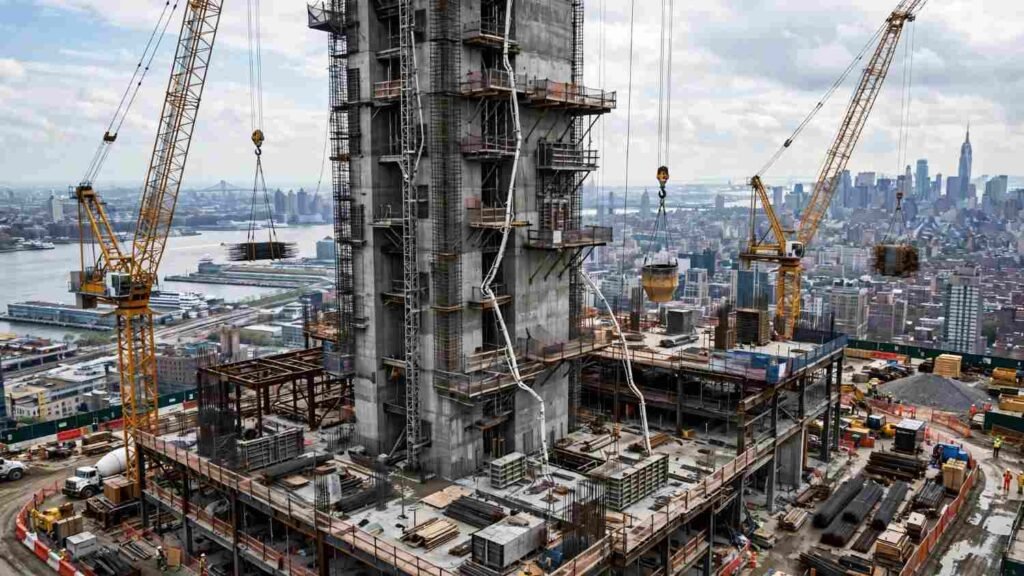
For owners, developers, and contractors working in the city, the tallest building ranking has real consequences. Building a supertall requires a concrete core built ahead of the floor slabs, a technique known as core-first construction that allows the tower to reach extraordinary heights without waiting for the full floor plate. The concrete pumps used on these projects operate at pressures that exceed most commercial equipment, and the logistics of hoisting materials to the top floors require tower cranes with custom mast sections.
Curtain wall installation at these altitudes happens under wind conditions that shut down work for days at a time, which is one reason the schedule on a supertall rarely holds its original date. The 2021 completion of 111 West 57th Street trailed original estimates by years, and that pattern is normal for projects in the 1,000-foot range. If you are planning any construction in this city, the delivery methods, hoisting equipment, and engineering review process all scale with the height you are trying to achieve.
Construction managers who work on buildings of this size also have to navigate Local Law 97 carbon emissions rules, facade inspection cycles under the city’s FISP program, and the crane permitting process through the Department of Buildings. None of these constraints disappear just because the building is tall. They multiply.
Several claims circulate repeatedly and should be treated with skepticism. One is that Central Park Tower is the tallest building in New York City because its roof is higher than the roof of One World Trade Center. That claim is true only if you use roof height as the sole measurement, and the CTBUH does not rank buildings that way. Another is that the old Twin Towers were taller than the current One World Trade Center. They were not, and the North Tower’s roof sat 408 feet below the spire of the current building.
A third claim involves the idea that 432 Park Avenue is the tallest residential building in the city. It is not. Central Park Tower holds that title. The confusion arises because 432 Park Avenue has the highest occupied residential floor in the Western Hemisphere, which is a different and far more specific record than overall residential height.
Several projects in the Manhattan pipeline could challenge the current record. The Affirmation Tower proposal on the West Side of Manhattan was designed at 1,663 feet, and it would have finished just short of One World Trade Center if built as originally drawn. Other sites along the Far West Side and near Penn Station carry zoning envelopes that allow similar heights. Whether those projects proceed depends on financing and air rights, neither of which moves quickly in a market where construction costs have doubled in a decade.
For now, the answer to what is the tallest building in New York City is One World Trade Center, and the correct figure to cite is 1,776 feet to the architectural top. Anyone who quotes a different number is measuring a different dimension, and the moment you understand which dimension they mean, the entire debate resolves into something construction professionals already know: the record depends on the tape you are using.
While modern skyscrapers showcase advances in structural engineering, exploring what is the oldest building in new york city offers a different perspective on how construction techniques and architectural priorities have evolved over centuries. The next tower that clears that mark will have to solve the same wind, zoning, and logistics problems, and it will almost certainly do so on a lot that requires a fresh air rights transfer to make the numbers work.