 11
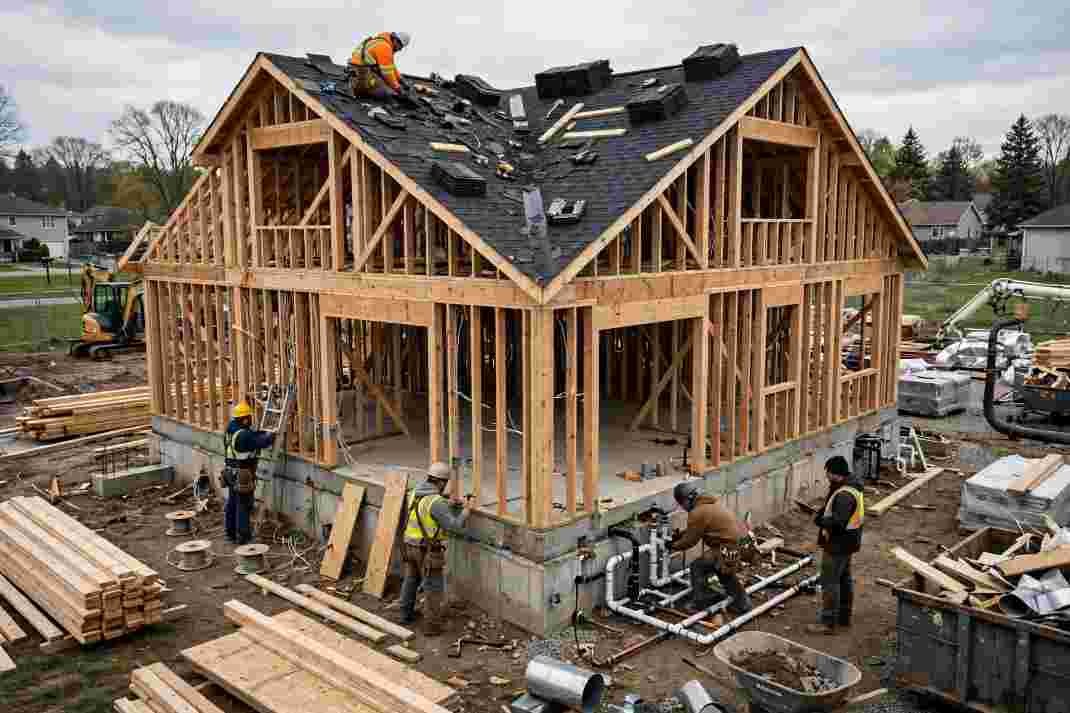
Asking how much does building a house cost is the first question every prospective owner asks, and the honest answer from anyone who has run a job site is that the number does not exist until the drawings, the site, and the finish schedule do.
What does exist is a defensible band. Custom home construction in the United States generally lands between $150 and $450 per square foot depending on region, lot conditions, and specification level, which places a typical 2,500 square foot build somewhere between $375,000 and $1,125,000 before land acquisition.
The National Association of Home Builders publishes a cost of constructing a home series that tracks this spread by builder type, and the gap between entry-level production work and architect-led custom work is wider than most buyers expect.
That range is not a marketing smokescreen. It reflects real divergence in labor markets, excavation difficulty, finish durability, and the permit regime governing the parcel. Anyone quoting a single number without asking about your lot is selling something. The rest of this article breaks the budget into the categories that actually drive it, so you can interrogate a bid rather than accept one.
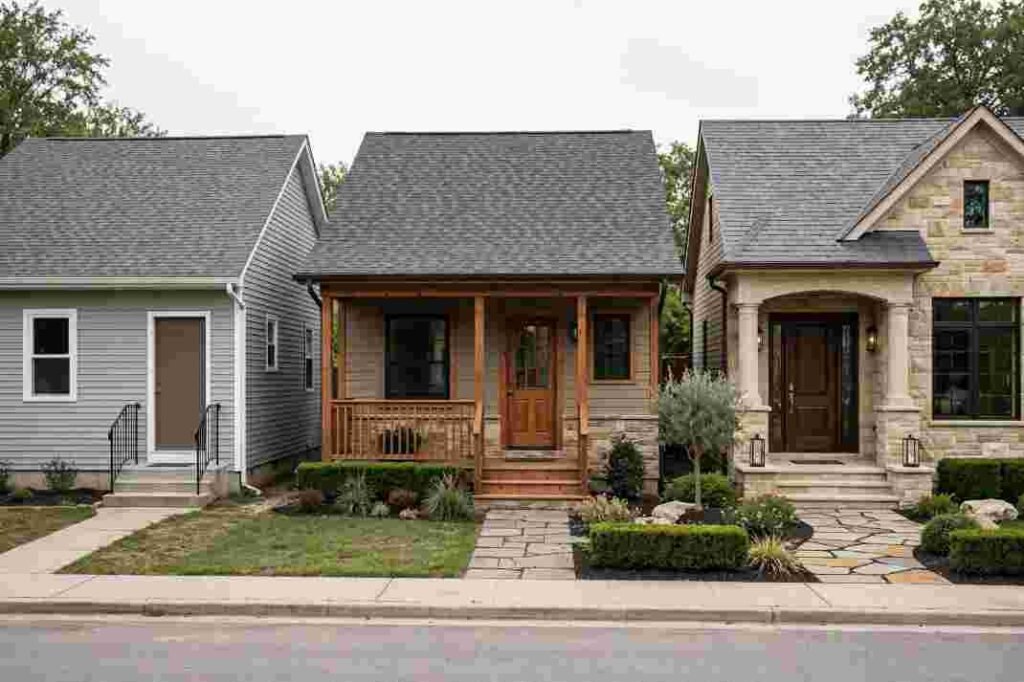
The largest single variable is what goes inside the walls. Two houses with identical footprints and identical framing can differ by hundreds of thousands of dollars once cabinetry, flooring, plumbing fixtures, window packages, and mechanical systems are selected. Production builders buy in bulk and standardize the menu, which compresses cost. Custom builders hand you a showroom and watch what happens.
| Specification Level | Cost per Square Foot | Typical 2,500 sq ft Total | Finish Profile
|
|---|---|---|---|
| Production / entry | $130 to $180 | $325,000 to $450,000 | Builder-grade cabinetry, vinyl or carpet, stock fixtures |
| Mid-range custom | $200 to $290 | $500,000 to $725,000 | Hardwood or LVP, semi-custom cabinets, upgraded windows |
| High-end custom | $300 to $450 | $750,000 to $1,125,000 | Architect involvement, stone surfaces, custom millwork |
| Luxury / architect-led | $450 and up | $1,125,000 and up | Imported materials, complex geometry, specialty systems |
When owners ask how much does building a house cost at the high end, they are usually underestimating the multiplier hidden in the word “custom.” A custom window package alone can run three to five times the cost of a standard vinyl unit, and a house built with forty windows turns that into a six-figure line item before a single appliance is chosen.
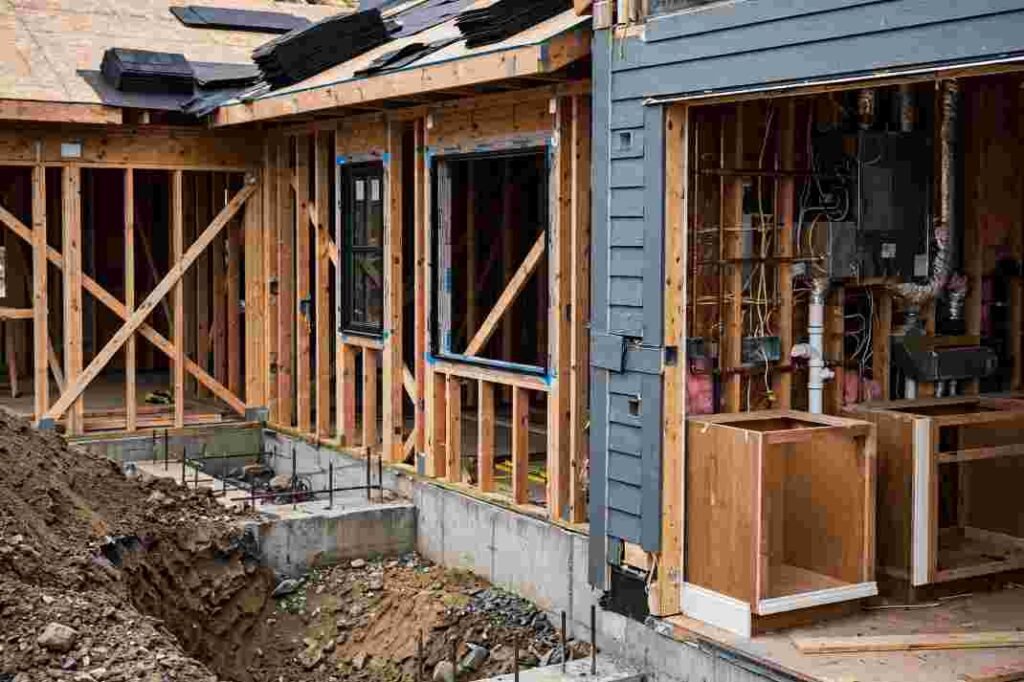
Contractors divide residential construction into hard costs and soft costs, and the split matters because soft costs are the ones owners forget to finance. Hard costs are the physical build. Soft costs bracket the project from design through final inspection.
Understanding the stages of a construction project also helps homeowners see when these expenses arise and how costs are distributed across the building process.
Soft costs typically run 15 to 25 percent of total project cost and include architectural and engineering fees, permits, impact fees, surveying, geotechnical testing, legal review, and construction financing interest. The U.S. Census Bureau’s construction spending data shows how much regional variation exists in the built environment, and permit fees alone can range from a few thousand dollars in rural jurisdictions to well over $40,000 in dense metro areas with impact fee schedules.
Hard costs break down roughly as follows for a mid-range custom build:
Those percentages are not a bid. They are a sanity check. If a proposal shows site work at 2 percent on a sloped lot with buried rock, something is being deferred or mispriced, and the buyer will meet that discrepancy later as a change order.
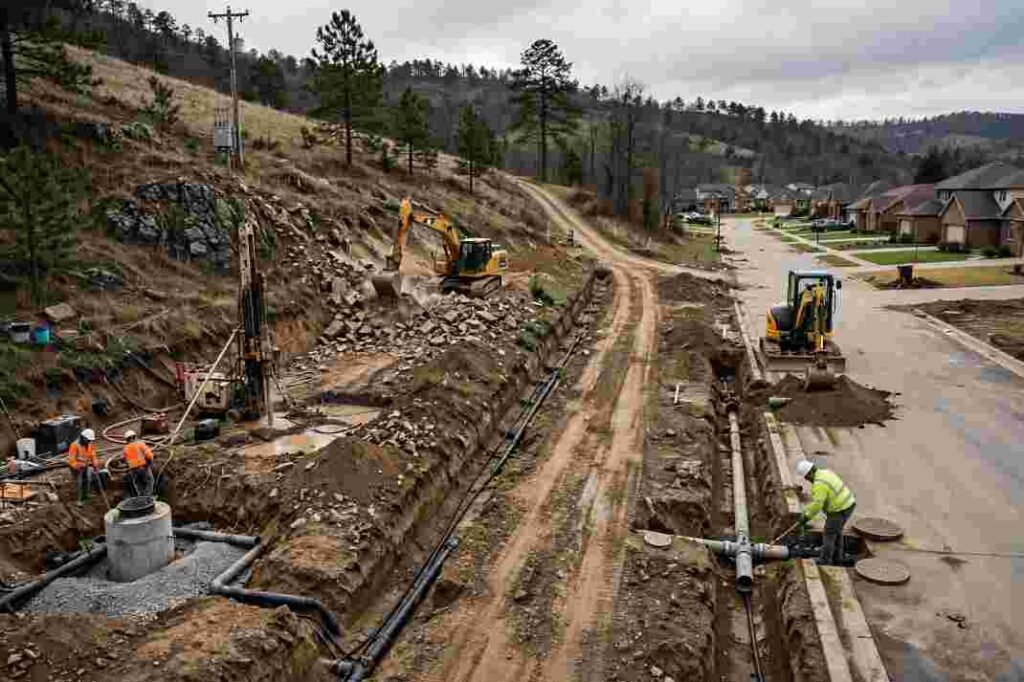
The lot is quietly the second-largest driver of how much does building a house cost, and it is the one buyers negotiate last and regret longest. A flat infill parcel with sewer, water, and power already at the street is a fundamentally different financial object than a five-acre rural lot requiring a well, a septic system, a long driveway, utility trenching, and possibly a power transformer paid for by the owner.
Rural infrastructure packages routinely add $50,000 to $120,000 on their own. Septic design and installation in soils that fail a percolation test can push higher. Excavation over bedrock adds days of equipment time. Stormwater management requirements in jurisdictions with strict grading ordinances can require engineered retention features that no buyer anticipates during the land search.
The Federal Housing Finance Agency tracks house price index data that shows how widely values diverge between metros, and construction cost diverges in the same direction because labor and materials follow local market conditions. A framing crew in one state can cost nearly double what the same crew costs three states away.
Any published figure answering how much does building a house cost is a national average that describes almost nowhere in particular. Coastal metros, mountain resort towns, and high-regulation jurisdictions all sit well above the mean. Rural areas with ample labor supply and lenient permitting sit well below it.
| Region Type | Typical Cost per Sq Ft | Dominant Cost Pressure
|
|---|---|---|
| High-cost coastal metro | $350 to $600 | Labor scarcity, permit timelines, impact fees |
| Mid-size growing metro | $200 to $320 | Material logistics, subcontractor availability |
| Rural, self-managed lot | $150 to $240 | Infrastructure, travel distance for trades |
| Resort and second-home market | $400 and up | Seasonal labor, design review, import costs |
A bid from a builder in a neighboring state tells you almost nothing about your project. The number that matters comes from a contractor who has pulled permits in your jurisdiction within the last twelve months and can name the inspectors and the subs by name.
Construction loans are not mortgages, and the difference changes the cash math. Most construction financing is drawn in stages as work is completed, with interest charged only on the outstanding balance during the build. That sounds favorable until the borrower realizes the lender requires appraisals, inspections, and a builder who has passed the lender’s vetting, which excludes many small contractors.
Carry costs also include the land loan if the lot was financed separately, insurance during construction, and the cost of the rental or existing mortgage the owner continues to pay while the house is unlivable. On a twelve-month build, those overlapping payments can easily total $30,000 to $60,000 and are rarely included when owners estimate how much does building a house cost in their planning spreadsheet.
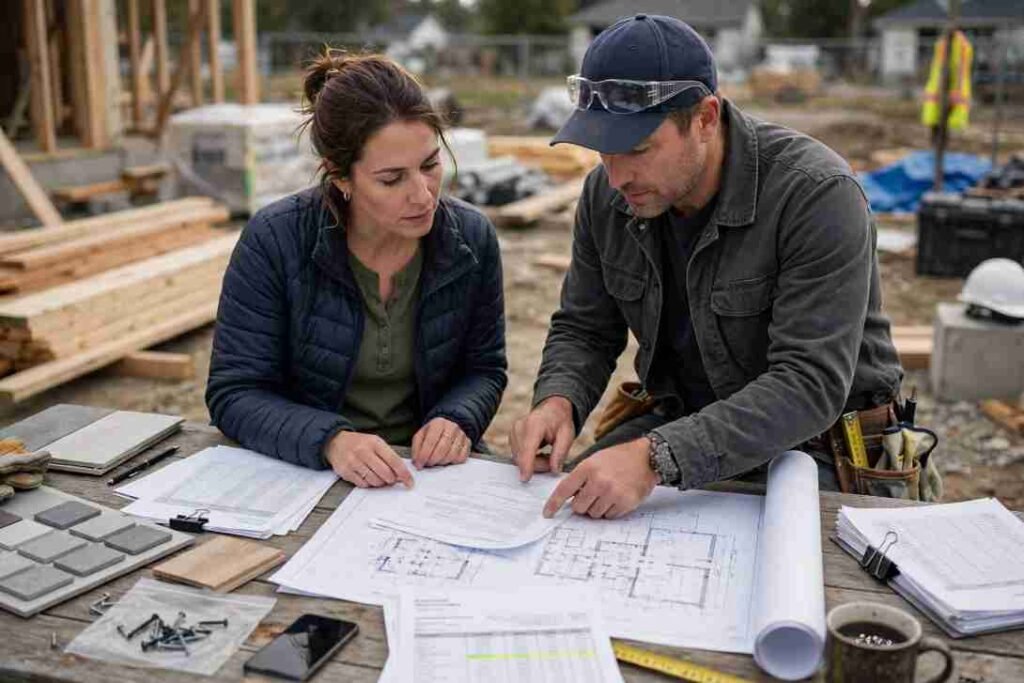
Every experienced builder carries a contingency line, usually 10 to 15 percent of hard costs, and every experienced owner learns why. Change orders are the mechanism by which a project that started at $600,000 finishes at $680,000. A wall moved after framing, a fixture upgraded after the rough-in, an appliance swapped after the cabinet order, each one carries material cost, labor cost, and often a markup on both.
The discipline that controls this is a completed specification schedule before the contract is signed, with allowances clearly defined and a written change order process. Owners who insist on this before signing generally finish closer to budget than owners who accept broad allowances and plan to decide later. When the question is how much does building a house cost, the answer priced at contract signing and the answer at final walkthrough are two different numbers, and the distance between them is a function of how many decisions were deferred.
Site surprises deserve their own line. A foundation that hits groundwater, a soil report that reveals expansive clay, or a utility easement discovered during excavation are not change orders in the ordinary sense. They are conditions of the land, and the only defense is a geotechnical report and a title search completed before the lot is purchased.
New construction rarely wins on headline price in a market with existing inventory, and buyers who approach it as a cheaper alternative to resale usually end up disappointed. What new construction buys is specification control, warranty coverage, and energy performance that older housing stock cannot match.
A buyer comparing a $700,000 new build against a $620,000 existing house is not comparing equivalent assets. The new house carries a builder warranty, current code compliance, modern insulation and window performance, and no deferred maintenance. The existing house carries the opposite risks, and the cost of remediating a failing roof or aging mechanical system belongs in the comparison even though it appears on a later balance sheet.
The Construction Financial Management Association and similar industry bodies publish construction financial benchmarking that consistently shows soft costs and contingency as the two categories most frequently underestimated in preconstruction budgets, and that pattern holds for individual owners just as reliably as it does for commercial developers.
The variables an owner can actually influence are specification choices, lot selection, and decision timing. Everything else, from lumber futures to local inspector availability, sits outside the buyer’s reach.
Homeowners who are still in the planning phase can also review how to start building a house to understand the essential decisions that should be made before construction begins.
None of these reduce how much does building a house cost in absolute terms. All of them reduce the gap between the estimate and the invoice, which is the number that actually determines whether the project gets finished without a second loan.
Anyone still asking how much does building a house cost without a site plan and a specification sheet is asking a question no contractor can answer honestly, and the sooner that question gets replaced with a scope document, a soil report, and three itemized bids from builders who work in the same county, the sooner the real number becomes visible.
The bids will disagree, sometimes by 30 percent, and that disagreement is the most useful information in the entire process because it tells you exactly which line items you have not yet pinned down.